
Guest post – Kale
Posted: December 14, 2015 Filed under: coming out, Testosterone | Tags: gender, gender identity, genderqueer, guest post, hormone replacement therapy, non-binary, queer, testosterone, trans, transgender 2 Comments
This is Kale with their partner, and a pitcher plant. Kale is the one wearing the hat.
And I guess I should start by saying that though I’m not experiencing any noticeable changes specifically from T, I have definitely noticed changes in my overall well-being from the moment I decided that I was ready to start taking T. It was kinda like this relief that, well, things might start to make more sense soon. So, I’m genderqueer, I have started calling my gender “confusion”, the act of feeling comfortable when people do not see me as male or female but instead are confused by my gender presentations. In my dream world children always ask me if I’m a boy or a girl and adults give me weird looks and avoid using pronouns for me. For the past two years I’ve gone by Kale and have used they/them pronouns when I feel like I can express that desire to others (I have a really hard time with coming out as GQ). In those two years I have increasingly struggled with who I am.
I came out to the head of the kitchen at my school (workplace)
Posted: November 30, 2015 Filed under: coming out | Tags: coming out, gender, gender identity, genderqueer, lgbtq, non-binary, queer, school, top surgery, trans, transgender, work 5 CommentsAbout 7 months ago, I came out to the principal at school. She asked me what she could do, and at the time I said nothing right now, but eventually I’d like to send out an email and go by a new name and male pronouns. I still cannot foresee when this email might happen, but I did get myself one step closer a couple of weeks ago.
I was filling in for my supervisor (working during the day while school is in session) and so I had some time to drink coffee in the kitchen and stuff. About a year ago, I told the head of the kitchen that I was getting testosterone from my doctor (because I was leaving to go to an appt. that day), and that I don’t feel like either a man or a woman. She didn’t say much at the time, but it felt pretty exhilarating to tell her anyway. She was also the first person at work I told I was getting married. One week before the date. I barely see her unless we’re working together over the summer, but over the years and years and years, I feel somewhat close to her, closer than anyone else probably.
So we were sitting drinking coffee, and this was around the time I was going to be taking a day off to travel outside of Philly to go to a consultation for top surgery. We were talking about the time off my co-worker was taking, so I just said that I’m taking a day off and I told her why. At first she was surprised and asked me why I would be getting surgery (she might have thought I had breast cancer?). I explained that I don’t like my chest the way it is, and I talked to her again about how I don’t feel like either a man or a woman. We talked about what she’d do if she did have breast cancer, and we talked about people who have gotten breast reductions. I then told her I’d like to go by male pronouns and a new name at work, but I’m just not there yet. She said, “Well you need to do what will make you comfortable.” Then a teacher came in needing something, so the conversation was over. But I was pretty much in disbelief I was able to tell her all this. It wasn’t premeditated like talking to the principal was. And she seemed to react positively.
Normally at work, I don’t see her because our shifts overlap by only about a half hour, and I don’t really have a reason to go say hi every day. But a couple of days after my trip, she came and found me and asked me about how it went. It made me feel really good – I did not expect a follow-up. I told her the out of town consultation went really well, and the one with the local surgeon did not go well. She name dropped a local plastic surgery practice that might do what I’m looking for, and I found out later through a facebook group that some trans-guys have gone to one of the plastic surgeons. Not sure whether I would pursue that or not, but it was nice she was thinking of me.
I’m not sure what’s holding me back from coming out at work, exactly, but it does feel like these spontaneous conversations are just more natural than a mass coming out email would be. I still think the email is necessary because I can’t talk to every person (or even more than a couple), but it just feels daunting…
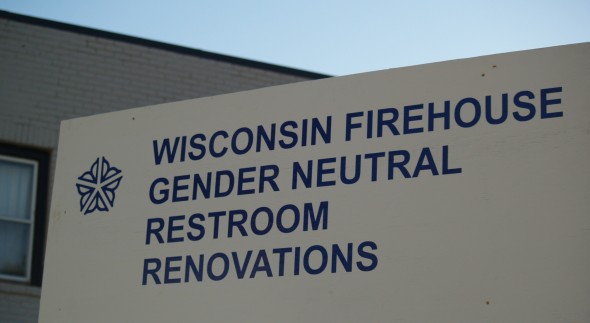
Local firehouse renovates bathrooms
Posted: November 18, 2015 Filed under: Uncategorized | Tags: bathrooms, gender, gender identity, gender neutral bathrooms, genderqueer, lgbtq, trans, transgender 4 CommentsWhile driving around the other week, my partner spotted this sign at the firehouse around the corner from us. They were temporarily closed while they renovated the bathrooms! I was floored by this – went back and took a photo of the sign. Way to go, neighborhood firehouse!
That specific trauma is no longer a big deal
Posted: November 11, 2015 Filed under: mental health | Tags: anniversary, anxiety, bipolar disorder, depression, emotions, medical treatment, mental health, psychiatric hospital, psychiatrists, psychotic break, stress, therapy, trauma 6 CommentsAround this time, 16 years ago, I voluntarily admitted myself to a psychiatric unit, but then I got stuck there for 19 days without knowing what was going on. The lack of communication was horrendous. I suffered a psychotic break and left with a diagnosis of bipolar disorder. I accepted this for years, and I internalized that I have a mental illness in some pretty detrimental ways. This has always stayed with me, always felt like something I needed to work through and get past.
Two years ago, I wrote about how I came to finally acquire my medical records from my hospital stay, and how I started to process things differently with the help of my therapist:
Continuing to work through a specific trauma
Last year, I wrote about finally bringing that record into therapy and how it felt to have her go through it. I was starting to realize that maybe I didn’t need to pick it all apart; maybe my perspective was shifting naturally, over time.
That specific trauma is still there
This year, although I’m acknowledging the anniversary, it feels like just the slightest emotional blip on my radar. I talked about it in therapy yesterday. I finally got my hospital records back from my therapist (she had been holding onto them for me for a whole year!) I looked through them again last night – there was always one page I skipped over. It was handwritten by me, explaining what had been going on in my social life that led me to feel like I needed to be hospitalized. I read it and felt OK about it.
Although this seems counter-intuitive, I think it helps that I was hospitalized in January. Where everything went wrong the first time around, everything went right(?) (maybe not right, but it went smoothly) this time around. I can overlay this experience on top of my shitty traumatic experience, and things make more sense.
I resisted the diagnosis of bipolar disorder for a long time, I’d been off all meds for 9 years; I felt relatively stable. When it was re-affirmed that I have bipolar disorder by the psychiatrist I was assigned, (“Once a bipolar, always a bipolar.”) I bristled at that. Actually, I bristled at him in general every step of the way. Appointments with him lasted a mere 2 minutes. He was inflexible and adamant I stay on meds forever. He forgot pertinent information about me. (At one point he told me I needed to stay on meds because I had been hearing voices.) After 6 months, I just stopped making appointments with him. With all his intensity toward me staying on meds, it was surprising how easily he let me just get away. Maybe he didn’t even notice I left.
My therapist helped me find a new psychiatrist; she’s awesome! She’s willing to follow my lead on what I want to do about drugs, and she’s willing to dialogue with me instead of ordering me what to do. I still don’t know what to do about drugs, but at least I have the space to feel supported with whatever I do choose to do. For now, I’m staying on them, but I can’t pinpoint why.
I respect this new psychiatrist. When she (also) told me I fit the criteria for bipolar type I, for the first time in a very long time, I felt like I could accept that. I don’t need to incorporate that in any particular way into my identity; it doesn’t need to mean I view myself differently. Personally, it’s not a core part of who I am. It just is an aspect of me that can just be, and I can leave it at that.
And I can finally integrate the difficult journey toward mental health as parts of myself, rather than things that happened to me.
Top surgery consultation #2
Posted: November 6, 2015 Filed under: top surgery | Tags: androgyny, ftm, gender, gender identity, genderqueer, lgbtq, medical treatment, non-binary, queer, self-injury, surgeon, top surgery, trans, transgender 27 CommentsContent warning: discussion of self-injury.
On Monday, I traveled to consult with Dr. Rumer, and the appointment went well. In stark contrast, I had a terrible consultation with a local surgeon, at a cancer center, yesterday. She mainly works with breast cancer patients, and the mail / paperwork I received in advance reflected this. (The center could easily draft up non-cancer related documents for trans-clients!)
I was there for a total of an hour and 45 minutes – lots of waiting! When I got there, I filled out paperwork about my breast cancer diagnosis. I just put N/A for a lot of it. Here’s a sampling of questions I was prompted to answer:
– What do you know about your diagnosis?
– Previous breast history?- Some cancers are more prevalent in persons of different racial and ethnic backgrounds. The following information will help us to better understand your potential risk in developing certain types of cancers and to understand your prognosis. [Followed by questions about ethnicity.]
– What percentage of waking hours do you spend up and about?
– more than 50%
– less thank 50% – I am confined to a bed or chair
– I am completely disabled, totally confined to a bed or chair
On the phone, when I scheduled the appointment, the woman was sensitive to the reason I was coming in, and to the fact I hadn’t legally changed my name yet. Regardless, that didn’t translate over to the present day, and I was called by my birth name and even, “Mrs. [last name].” I don’t think I’ve ever before been called “Mrs. [last name].”
I finally was brought up to the breast cancer suite and my vitals were taken. I waited in an exam room and a nurse came in and went over some of the questions with me. She left for a while and came back, saying, “let’s fill out this paperwork.” This one WAS relevant to why I was there. I asked her, “Why was I filling out papers for breast cancer patients?” She replied, “Oh, well, they just gave you the wrong one down stairs.” No big deal… ???
She left and a doctor with an intern student came in. The doctor asked if it was OK if the student was present, and introduced her. She then asked, “Are you so-and-so?” I said no I’m not. She said, “oops, sorry, wrong room.” I sat there waiting a while longer and finally the surgeon came in with TWO student interns. At no point did she ask for my consent for them to be present. They introduced themselves and we got started. She started by putting words in my mouth – “So you’ve felt this way since you were a teenager. That’s when you started feeling different…” I just let her roll with that. She asked about mental health, suicidal thoughts, and even self-injury. I’m not sure why. She asked very little about gender identity. I answered her questions honestly, including that I’ve had vague suicidal thoughts, and I used to use self-injury as a coping mechanism.
She then said they were going to leave the room and prompted me to put the robe on. They were gone a very long time. They all came back, rubbing hand sanitizer into their hands. I had a flash fear thought – are all these people going to be touching me?!!! Fortunately only the surgeon touched me, but the presence of all these people was enough for me to check out for this part of the appointment. A few things that registered:
– She commented on my tattoo, asking if that was magic marker – it looked like marker. ???
– She talked a lot while I was sitting there half exposed. She described the procedure she would do, and manipulated my breast in her hand to demonstrate it. I looked down briefly, and seeing her grabbing my breast was totally surreal. She was talking at my chest, and not to my face. I was poked and prodded a lot more than seemed necessary.
– She actually said to me, “This scar, is this from cutting?” I could not believe I was being asked this. I was in shock.
– I was aware of interns in the background, watching this whole thing. They were fuzzy.
– I said to her, “I’m just in the consultation phase, and I have some questions for you.” This changed the dynamic and she wrapped up the part where I was sitting there, vulnerable.
When this part was finally over, they left and I got dressed. I waited a very long time again. When they came back, I went through my list of questions. She has a year and a half of experience working with trans-patients (really?!!), and does chest masculinizing surgeries a couple times per month. She requires patients to be off T one week before and one week after surgery. 50% of patients will immediately retain nipple sensation, and 80% will eventually over time regain sensation. She could not show me any examples of her work that would be related to my surgery type. She could not tell me how much it would cost, not even a ballpark estimate.
Before leaving, I gave her feedback. I told her how I had been misgendered by the staff. She conceded that they needed to work on that. I also, in front of the students, said, “As someone who is transgender, I have gender dysphoria around my naked body. These may not be the best types of appointments to have students present. It felt like I had an audience, and I didn’t feel comfortable being partially exposed.” She responded, “Thank you for that feedback.” I understand she might not have control over when she has interns with her, but she could CERTAINLY ask for consent, or ask that the interns not be present for the naked part. I wanted to give her more personal feedback, such as, “It’s not appropriate to comment on my body,” but in the end I didn’t go there. I just couldn’t right then.
This surgeon and the staff could benefit from some trans-related training, particularly to the sensitivities trans-people may feel about their naked bodies, specifically chests. Make it short and sweet!
Top surgery consultation #1
Posted: November 3, 2015 Filed under: top surgery | Tags: androgyny, dr. rumer, gender, gender identity, genderqueer, lgbtq, non-binary, queer, surgeon, top surgery, trans, transgender 14 CommentsI traveled to Ardmore, PA and met with Dr. Rumer yesterday. The consultation went well overall, and it’s prompted me to start looking at lots of top surgery photos online, something I’ve done in the past, but without much of a framework or focus.
She’s located in a college town / upscale suburb of Philadelphia, and her office / house(?) is a white brick old Victorian creepy looking place. Very apt for visiting 2 days after Halloween. There is street parking, and you have to get buzzed in. I was envisioning a medical center of some sort, but this place had the vibe of a hair salon – everything was whites, greys, and black, very sleek and futuristic looking. The receptionist offered me something to drink. I arrived early and was seen by the nurse practitioner right away. She also offered me some water or coffee.
We went over my medical history I had filled out online in advance. I guess I forgot to add in testosterone under “medications,” and she understandably assumed I wasn’t on T. When I said I am on a low dose, she added that information. (Being on T is NOT a requirement for getting top surgery.) She also asked about how I identify, if I could provide a letter from a mental health professional (required), if I have legally changed my name, am I out to everyone in my life, and how long have I gone by male pronouns. There were no issues or clarifications with any of my answers: That I am not FTM, I identify as non-binary, I can get a letter, I have not legally changed my name, I’m out to everyone except work, and I’ve gone by male pronouns for close to 10 years. (That got a “wow” out of her, haha.) I’m glad she didn’t ask me about gender dysphoria or how I felt about my chest, because I wouldn’t have known what to say / didn’t have a statement prepared. Even though it seems like if I’ve made it this far, I should be able to articulate that!!!
She made sure I understood that I would be putting on an oversized paper vest momentarily and that Dr. Rumer would be looking at my chest. Was I OK with that? I said yes I expected as much.
She said she’d be back with Dr. Rumer, and gave me a moment to put on the vest. They re-entered, Dr. Rumer said, “Nice to see you again.” (Presumably because I’d said I’d heard of her through the Philadelphia Trans-Health Conference, although I didn’t go to any of her presentations or actually meet her.) She looked at my chest for literally one second (I’m glad it was so brief) and declared I could go with peri-areolar if I wanted. Is that what I wanted? I said yeah, probably.
From there, she showed me a few slides about what to expect, and she showed me two before and after pictures. The only disappointing aspect of this appointment was I asked her, “Do you have more pictures?” and she replied that she doesn’t really because they are all the same. I was pretty dissatisfied with that – it gave me the feeling that these were the two best that she had hand picked to present. I would have liked to see a dozen examples of peoples’ chests; there aren’t that many online.
Other than that, she was very friendly and personable and she answered all my questions thoroughly.
- What are the odds of retaining nipple sensation? Only less than 1% will not retain sensation. (Those odds seem too good to be believed; I’m not sure I totally believe her!)
- How many appointments are required? A lot! One a week before surgery, one a week after surgery, then a few at different intervals (I can’t remember) and one at the one year mark. For people out of town, most of them can occur over skype if everything is going smoothly. The only necessary travel is for the surgery itself, then a week after, and then a year after.
- Do you have to go off T before surgery? Yes, you have to be off T 2 weeks leading up and 2 weeks post-surgery. Why is this? Because of risks of excess bleeding. I feel resistant about this and still don’t quite understand, but I’ve heard it before and would have to accept it.
- How long can I be out of work? I have a very physical job. She would write me a letter to go back whenever I want, especially since I have sick time accrued and wouldn’t be on disability. I’d probably look at 6-8 weeks.
- Do you resize nipples? She resizes areolas, and nipples retract on their own.
- The total costs she quoted me, including staying 2 nights in her office(?) / home(?) / guest rooms is $7,480. That seems on par with other surgeons, maybe a little on the high side.
I have another consultation on Thursday with a local surgeon. I will be curious how the two compare.
Moving forward with the process of getting top surgery
Posted: October 22, 2015 Filed under: top surgery | Tags: androgyny, ftm, gender, gender identity, genderqueer, lgbtq, medical treatment, non-binary, queer, top surgery, trans, transgender, transition 20 CommentsI have two consultations within the next two weeks with surgeons. I can’t believe I made it this far – I didn’t always know I would get top surgery. Even now, I’d say I’m about 99% certain, but I’m still hesitant to talk about it or write about it. I’ve never written about it here other than just quick, vague mentions.
There were some hang-ups I had to work to get past (and I’m still working through) in order to allow myself to feel like I can do this:
It is a want, not a need. I don’t need this – I’d say it’s been a persistent nagging feeling for years and years and years, but never an intolerable feeling of disgust or revulsion. If my chest is not a source of gender dysphoria in a way I can’t live with, can I still get top surgery? Yeah, why not? It will definitely improve my quality of life. Throughout adulthood, I have fantasized about wearing t-shirts or tank tops in the summer, without a binder. I avoid binders when I can, which leads me to another hang-up…
My chest is small. My chest is so small that it seems like I could just live with it how it is. Can’t I just live with it? It’s not cumbersome; I don’t have to do much to hide what I have. In the winter, it’s not much of a problem. I can just layer and I don’t have to bind. In the summer, I think about it all too much. Sometimes I bind; other times I just attempt to layer and be hot.
Ultimately, my chest doesn’t look how I think it should look, and if I have the means to change that, I don’t see why I shouldn’t. Urgency (and my lack thereof) plays a role in whether I think I get to do this, but I can get over that. I think. I have a lot of shirts I’d like to wear, but don’t. Because they don’t look right. I spend a lot of time thinking about how my body could look different.
For a very long time, I thought I would get top surgery one day, but I had no idea how to make a first step. Which just tells me I probably wasn’t ready yet. It seemed so daunting as to be impossible. Finally, this summer, I was corresponding with a trans-guy I know locally, and he said he got surgery in our city. That blew my mind – I didn’t know there was anyone here.
I started looking at a Facebook group where others had written about their experiences with her, and I could suddenly wrap my head around moving ahead. I called and booked a consultation for a month away. As soon as I did that, more doors opened up. I could suddenly envision traveling, meeting with other surgeons, all the stuff involved in getting top surgery, usually. I did minimal amounts of research (I already know a bunch of surgeons by name – I’m sure I will do more research. It’s going to be a long process) and called Dr. Rumer’s office, about 5 hours away. I’ll be traveling just to meet with her. That seems huge. She waived the consultation fee because I have been to the Philadelphia Trans Health Conference, one of the many places she presents at. That’s pretty cool.
These consultations happen to be only 3 days apart – it’s going to be a busy week, coming up.
How It Is To Be Miss Tobi
Posted: October 16, 2015 Filed under: Uncategorized | Tags: androgyny, art, Berlin, film, gender, gender identity, genderqueer, lgbt, lgbtq, non-binary, queer, trans, transgender, video 3 CommentsI’ve been corresponding with Linda Coussement, a video artist from the Netherlands. She reached out because she recently made an awesome short video (3 minutes) about a transgender artist in Berlin. She thought people who read my blog would enjoy it. So, here it is, along with further information about Linda and a short interview:
Miss Tobi is a 44 year old anarchist who makes amazing metal sculptures, plays in several performance art groups, and is also a part-time physical therapist. Check out the video!
Linda: “My background: Well, my name is Linda Coussement, I’m 36 years old and I’m from the Netherlands. […] I’ve only recently decided to step out of the business world and follow my (he)art on this epic adventure. I used to work as a business coach but I now plan to make a living through these videos somehow. On the short term I will probably have to get by on donations and funds, on the medium to long term, I plan to have books, events and workshops to sell.
What’s perhaps also good to know is that I’m not just doing this for myself and my own personal growth as a human being. I ultimately wish to inspire as many people as possible. To show that we’re all human beings, no matter what we look like, where we’re from or what we do. We all love and fear. We all have hopes and dreams. And we all sometimes struggle with relationships, money, confidence and loneliness. Personally, I’ve learned that the moment you realise this is the moment you can empathise with another person and because of that build a meaningful relationship. And that’s what I would like to see more of in the world!”
JQ: How did you get into this project? What inspired you?
LC: I’ve spent about 12 years in the business world (amongst other things as a business consultant and startup cofounder) but I’ve always had a keen interest in the more human side of life. This expressed itself through teaching yoga, doing lots of personal development training courses and coaches and being overall very reflective of myself and life in general. Though this question popped up in my head a few years ago, it was in May of this year that I realised that it was this human side that I wanted to explore more at this point in my life and I made a spontaneous decision to ask the question ‘how is it to be you?’ to all sorts of people around the world (hence renting out my house and traveling) and document it through blogs and video.
JQ: Is this video part of a larger series, or does it stand on its own?
LC: This video is the first of a much larger series. There will be supershort videos on Facebook (where I randomly ask people in the street this question), these 3 minute videos (the next one will be about a banker turned hand made paper maker in the Czech countryside) and ultimately a book, a long documentary and live events. Concerning the video of Miss Tobi, it’s very likely that I’ll also make an 8 minute version that will be sent into several festivals.
JQ: How did you meet Miss Tobi? What came first, meeting her, or the idea for the video?
More information can be found here: How It Is To Be Miss Tobi: I Don’t Feel Like a Woman, I Don’t Feel Like a Man, I Feel Transgender
Outdated trans programs pt. 3
Posted: October 13, 2015 Filed under: coming out | Tags: estrogen, ftm, gender, gender identity, genderqueer, hormone replacement therapy, lgbt, lgbtq, mtf, queer, testosterone, trans, transgender 2 CommentsMy partner and I uncovered a video I had gotten while in a support group about 10 years ago – a collection of trans-related TV programs from the late 90s / early 2000s. We’ve been spacing it out, watching some of it each weekend.
The first weekend, we watched The Discovery Channel’s “Changing Sexes,” from 2002. It was appalling.
Next we watched an Oprah show about transgender kids, from 2004. It was surprisingly well done.
Part 3 was a program on A&E from 1998 called, “The Transgender Revolution.”
As soon as we started watching it, my partner said she remembered seeing it in a class at College – that’s pretty cool. And her reaction was positive, like it had been worthwhile. And it was – it showcased a few trans-people in respectful and dignified ways. It was also the most political, by far. There was a clip of Leslie Feinberg, and there was footage of Riki Wilchins talking about hate crimes and founding Gender PAC. She talked about going to senators to get policies changed, and going to the APA to get “Gender Identity Disorder” changed. Brandon Teena was talked about, as well as two more recent cases of the murders of trans-women.
The first portrait focused on Tonye, from Tampa, FL. He lives on a farm, works as a sheriff, has a wife and 8 year old daughter. He talks about all the discrimination he has been up against at his job. He also says his community has been hostile – his farm animals have been killed; other times they have been turned loose. He started an online group called TOPS – Trans Officers Protect and Serve, in order to get support for people like him. He had to undergo an internal confidential criminal investigation at his job, which he says is just a pretext for prejudice. It was left on an uncertain note – we don’t know the outcome of his struggles at work.
Next the program focused on Nancy Nangeroni, an engineer from MA. She talked a lot about overcompensating and living as a very macho guy, taking a lot of risks. The turning point for her was when she endured horrible injuries from a motorcycle accident – she realized she could not keep living the way she had been. One great quote from her: “I’m not a pre-op or a post-op because that’s not what defines me as a person.” She founded the IFGE – International Foundation of Gender Education.
The third portrait was really moving because it was done anonymously. “Terry” never showed his face, and neither did his wife and his mother. He owns a construction company and lives completely stealth. He equated being trans to having cancer – it’s something that you live with, and getting treatment is a matter of life and death. His story focused on him getting metoidioplasty. It was made clear that he needed this procedure to be legally recognized as male – he was living in fear of being outed because his documents all had an “F” on them.
The program wrapped up by discussing the extremes of gender in the society we live in. Toys, etc. “In time, the movement may leave America forever changed.” A nice note to end on.
Outdated trans programs pt. 2
Posted: October 2, 2015 Filed under: Uncategorized | Tags: children, coming out, ftm, gender, gender identity, hormone replacement therapy, lgbt, lgbtq, Oprah, queer, raising children, testosterone, trans, transgender 10 CommentsMy partner and I uncovered a video I had gotten while in a support group about 10 years ago – a collection of trans-related TV programs from the late 90s / early 2000s. We’ve been spacing it out, watching some of it each weekend.
The first weekend, we watched The Discovery Channel’s “Changing Sexes.” It was appalling.
Last weekend, we watched an Oprah show from 2004 about transgender children. Surprisingly, it was so well done that it felt relevant and spot on, for children today, more than 10 years later. Oprah made some blunders in terminology and wording (“transgenders,” “When you grow up, what? You want to officially have an operation?” “Children who suffer from gender confusion”), but other than that, the tone was surprisingly respectful.
The show focused on 3 families:
Kaden, an 11 year old FTM trans-person, and his mom.
Dylan, a 5 year old child who strongly feels he is a girl, and his parents.
Hal, a 9 year old FTM trans-person, and his parents.
Kaden’s story focused on how horrific it was to start puberty, his social transition, and how hard it’s been for his mom, although she is supportive. His mom talked about him being able to take further steps, (hormones and surgery), when he’s 18. I found this video and article on Huffington Post – a Where Are They Now from 2013, where Kaden is 20. He ended up getting to start testosterone at age 14 and get top surgery at 16. He seems happy.
Dylan’s story focused on the tension between the parents and between Dylan and his dad. His mom is fine with his son’s preferences and who he might turn out to be. She will buy him dolls and engage in discussions about how he feels he is a girl. His dad does not approve, and there is already a big rift in his relationship with his son. The parents fight about it. The dad stated, “I discipline him.” Things seemed skewed in a way in which the dad was demonized. Dylan was not on the show, but he was shown backstage, happily coloring.
Next, a gender therapist talked about the best practices in how to handle a child going through this. To just be there for the child and love them no matter what. And it might be a phase; it might not – and that’s OK. She claimed that about 1/3 of children grow out of it, 1/3 grow up to be gay, and 1/3 grow up to be trans. I wonder if these statistics hold up?
Hal’s story focused on how open and accepting his parents were, after he verbalized suicidal ideation at 6 years old. His parents claimed that Hal can make his own choices about his path, when he is ready. They talked about difficult moments, and Hal was kind of put on the spot. At 9 years old, I think he was too young to be on the show, talking about his story. He was crying through it. That was hard to watch.
Lastly, a MTF trans-adult came on the air to talk about her life path and how much easier it could have been if she had been able to transition at a younger age. Instead, her doctors were suggesting a lobotomy, and her family was seriously considering it. Luckily they didn’t go through with it, and she grew up as male, had a family (is now divorced but it seems amicable) and is living more authentically now.
This show touched ever so briefly on heavy issues, but shied away each time. Hate crimes were brought up. Homelessness. Suicide rates. Racism. Class issues amongst the families could have been explored. Oprah tends to focus on the positives, which is definitely doing a disservice. But in terms of talking about what kids need, she directed the conversations in the right directions.
The show closed with Dylan’s dad proclaiming that he is now going to go buy his son some dolls when he leaves. When Oprah asked why, he said, “Life is more important.”
Stay tuned for part 3: A&E The Transgender Revolution from 1998.

 janitorqueer