
Gender specific toys: advice column Q&A
Posted: November 19, 2014 Filed under: Uncategorized | Tags: advice, advice column, androgyny, emotions, family, family dynamics, gender, gender identity, genderqueer, lgbtqia, non-binary, queer, relationships, siblings 2 CommentsI came across a question and answer from a nationally syndicated advice column the other day. I read this in my local newspaper and got such a kick out of it I brought it home to share with my partner:
My 7-year-old daughter loves playing with her 13-year-old brother’s toys. She has her own toys, but she does not play with them because she said that boys’ toys are “way cooler.” I don’t know what “way cooler” means, but I would prefer my girl to play with her toys. Do you think I am wrong for thinking this way, or should I find “cooler” girl toys for my daughter to play with?
-Daddy’s Little Girl, West Orange, NJYour son’s toys will be fascinating to your daughter no matter what they are, because they belong to her big brother. Her desire to play with them shows her interest in connecting with him. Chances are, if you bought her duplicates of all of his toys, she would still choose to play with his. This could be extremely annoying to your teenage son, who is probably doing his best to grow up and be independent.
Suggest to your son that he devote some of his time playing with his sister. Enjoying a bit of her brother’s attention should help her to become less obsessive about his toys. Suggest that your son let her play with one of his toys on a regular basis as long as she agrees that she will not touch any of his other toys without his permission. Negotiating playtime and boundaries should help them to find a comfort zone.
When I read this, it felt like a tiny victory. This parent was, essentially asking what to do about the gender-anxiety-inducing situation of her offspring playing with the wrong type of toys. Should she find cooler girl toys so her daughter will be more drawn to the right ones? She wants her girl to play with girl toys.
Normally, I’d be miffed that the advice columnist didn’t address the question / concerns. But in this case, it’s so refreshing that gendered toys was not touched on whatsoever. Rightly so – seems like a non-issue. Also ignored was the impulse to buy more toys and control the daughter’s desires. Instead, the columnists focused on cultivating a good relationship between the brother and sister based around spending time together and creating boundaries. And also pointing out how the 13-year-old must feel about all of this.
It’s not about girls’ toys and boys’ toys. It’s about family dynamics and finding what’s best for everyone. The columnist gets it! Spread the sentiment!
That specific trauma is still there
Posted: November 13, 2014 Filed under: Uncategorized | Tags: anxiety, bipolar disorder, depression, medical treatment, mental health, psychiatric hospital, psychiatry, stress, therapy, trauma 3 CommentsAround this time (middle of the night), fifteen years ago, I started a game changing series of events by getting my mom to bring me to the hospital, from which I was admitted (voluntarily) to an adolescent psychiatric unit. Once I was actually there, I didn’t want to be there anymore, but a lot of things were changing, and I ended up having to stay for 19 days. I left with a misdiagnosis of bipolar disorder and prescriptions for Depakote (mood stabilizer), Risperdol (antipsychotic), and Wellbutrin (antidepressant). The medications changed a lot over the years… I’m happy to report I’ve been med-free for about 9 years at this point.
Last year, I wrote about how I came to finally acquire my medical records from my hospital stay, and how I started to process things differently with the help of my therapist:
Continuing to work through a specific trauma
This year, I finally brought this massive document in to therapy with me, despite the fact that I was pretty unsure, er maybe more like totally ambivalent, about what I wanted to get out of talking about it (yet again) exactly.
My therapist started reading through the pages out loud, and simultaneously made comments and processed it in her own way. At first this felt tedious (the thing is 210 pages long!) But I also felt intrigued. It was much more helpful for her to tell me about the content than for me to try to go through it myself (which I hadn’t done since first receiving it, last year). I also started to feel yucky and shut-downy. I finally verbalized, “Let’s take a break.” I was worried this therapy session was really going to have a negative lasting impact on me, but, in fact, I felt fine afterward. Maybe I’m more resilient these days than I think.
I used to always think that if I do this one thing, or if I find out these missing pieces, or if I reflect back in a different way, the pain of that experience will be lifted. If I just keep grinding into it and picking away at it, I’ll one day be free. Now I know that this can’t really happen. And I can accept that it was a shitty thing that probably didn’t actually need to happen. It was traumatic. It was so long ago. I can look at it with a completely different perspective by now, but not because of anything I did – that perspective shift happened naturally, over time and with personal growth.
There is so much I could write about. But I actually really only want to write about one thing right now, as it relates to my hospital experience: while I was there, I wore this one particular hoodie constantly. And once I was released, I never wore it again. But there seems to be no way I can get rid of it. I brought the hoodie in to therapy, along with the document, and told her all about it. When the document felt too overwhelming to keep delving into, I told her she should just hold onto it and go through it on her own time. She asked if she could hold on to the hoodie too. I said, “yeah sure.”

My hoodie sported this sports logo.
The reason I loved the hoodie so much was because the LA Rams were not a team. (I just looked it up, and they were a team from 1946-1994). I worked at a thrift store and picked up this gem at some point. I liked the incongruousness of it. I do not like football.
Party, vacation, and TERFs
Posted: September 1, 2014 Filed under: Uncategorized | Tags: butch, emotions, feminism, gender, genderqueer, getting gay married, lgbtqia, marriage, queer, radical feminists, relationships, TERFs, trans, transgender, wedding 7 CommentsMy partner and I made it through this party I’d been half-dreading, a party to celebrate our prior unification ritual. It was a lot of things, but largely, it felt validating and joyous, in a chaotic sort of way. It was fun; we would not do it again! It was a different kind of experience for me; I was on a natural high for so long, it was starting to get tedious. I mean, I’ve had a lot of extreme highs and lows in moods, over much longer periods of time, but this was somehow different. Somehow much less scary. I felt confident that even though I felt this way, I could depend on myself to do whatever it was I needed to do. It was a high that was not really all that fun, in its duration. Maybe I am growing up.
High extended roughly, from Thursday (kicking the planning for Saturday into high-gear,) till Tuesday (by then, we were in Northampton, MA for the start of our vacation, and the long drive to get there felt like it happened in a snap.) I wasn’t hungry; I wasn’t sleeping well. I was able to just keep going and going and going regardless. I didn’t particularly feel euphoric or excited (I mean, I did at times, but not sustained.) I basically started feeling like all I wanted was to get a full night’s sleep, an entire meal in my stomach, and to come down from wherever up-in-the-clouds I was.
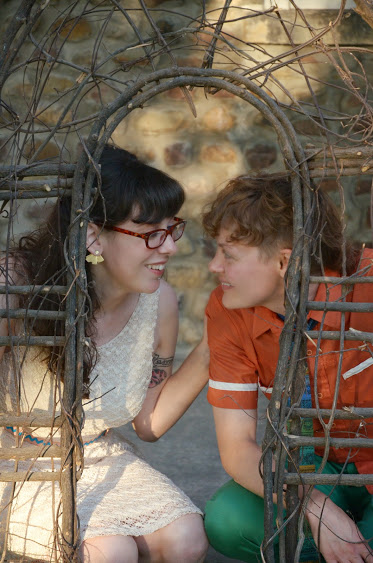 On our vacation, we stopped through Northampton and Spencer, MA before heading up to a tiny town (talking about a town with a church and a convenience store. No gas station.) in central Maine. We stayed with two friends who have an awesome cabin they’ve basically created themselves, over the past 10 years. It sits on 50 acres of land, and they live there part time. We went blueberry picking (organic! $1.50/lb!!!), swimming in a very cold lake (when the air temp + rain hitting lake was even colder), trouncing through the woods a bit. We kicked back, did some reading, connected with our friends, and heard stories about / met some of their neighbors.
At a rest stop on the way up there, I did an awkward dance with an older woman over the fact that I was in the women’s bathroom. She spun around to walk back out and check if she was in the right one, sort of touching my shoulder to prevent a collision between us, saying she’s checking that this is the right bathroom. I smiled and said, “Yep, it is.” This, surprisingly, does not happen to me often at all. I can’t even remember the last time. I enjoyed the experience (since it wasn’t threatening or uncomfortable, was in a way validating.)
On our way back home, we stopped to stay in a tree-house!  And on our way from Maine to this tree-house, my partner read aloud an article from the August 4, 2014 edition of the New Yorker (p.24 – “What is a Woman? The Dispute Between Radical Feminism and Transgenderism”). I’ve never picked up a New Yorker before. (I think maybe my partner hasn’t either, because she commented, “There are a lot of comics in here!” Haha.) It had been given to us by our friend in Maine, because she knew we’d be interested in this one article.
Imagine driving on winding roads through rural VT, rain coming down, having previously been bored out of my gourd, tired of our musical selections. And suddenly being fully engaged in this topic that seemingly came out of nowhere (I mean, I know it came from the New Yorker; I just mean I wasn’t prepared for it, but it surely was a much needed distraction right then.) At various points, I interrupted my partner to argue passionately both with the article itself and with the radical feminists the article was about.
Some of the gists:
– Not all, but some radical feminists still feel that transwomen are not women and will never be women (and that they benefit from male privilege…?). These rad-fems continue to want to exclude transwomen from women-only spaces, and to invalidate their experiences in numerous other ways. They reject the notion that someone could feel intrinsically female or male, and that all the ways that women and men are different are due to sociological forces and learned experiences only.
– The common term for these rad-fems is TERF (trans-exclusionary radical feminists).
– Some TERFs are detransitioners, and TERFs often cite detransition as proof of the fallibility of transgenderism. (Expert reports state that the percent of people who detransition is somewhere between 1% and 5%. This is higher than I would guess, but hardly significant enough to attempt to build a case.)
– Some TERFs face threats, both in their personal and professional lives. Situations have become so escalated at times, that they must be escorted by security to events and go underground in their academics.
There was so much more to this article (such as why FTMs are OK, but MTFs are a threat -??? Maybe I’ll return to the article for a more in depth future post); I highly recommend seeking it out if you can. It was eye-opening for me because even though I’ve heard of this term (TERFs) and understand the basics of the arguments, this really painted a picture. On the one hand, TERFs’ arguments are terribly weak and seem fueled by fear and a lack of understanding, with no efforts to begin understanding.
On the other hand, I find myself empathizing (just a little.) “TERF” is not a self-describing term. It is essentially yet one more slur, coming from others in sexual/gender minorities – people all too familiar with slurs themselves, usually. These women have fought passionately (sometimes for decades and decades, creating groundbreaking groundwork) for changes in the view of what it means to be a woman, and now they’re kinda in over their heads here. One final passage from the article that really sums up how this sub-group of rad-fems must feel,
“[These] radical feminists find themselves in a position that few would have imagined when the conflict began: shunned as reactionaries on the wrong side of a sexual-rights issue. It is, to them, a baffling political inversion.”
Good doctor news
Posted: August 21, 2014 Filed under: Testosterone, Uncategorized | Tags: androgyny, doctors, gender identity, genderqueer, hormone replacement therapy, lgbtq, lgbtqia, medical treatment, non-binary, queer, testosterone, trans, transgender 8 CommentsThree months ago, I finally found a good doctor, but I was unsure if I’d be able to keep her. I liked her style immediately – ability to communicate, upbeat and straightforward manner, etc. And I liked her entire office’s professionalism. However, she had no trans-related experience, and after I told her my reasons for being there, she seemed hesitant to keep me on as a patient. She said she would look into finding a specialist I could go to, or at the very least, that she could consult with before proceeding. In my head, I was thinking, “Good luck with finding people locally! How do you think I ended up here, with you?!!” Haha.
We had a follow-up appointment yesterday. Going into it, I wasn’t sure if she was just going to say, “So I’m going to refer you to so-and-so,” and I’d have to start all over again with someone new. I was nervous; I didn’t want that. I had convinced myself, to an extent, that that was what was going to happen.
If you’re interested in reading through this epic journey to find a new doctor, here’s where I’ve been, in backwards order:
From 3 months ago, Convincing doctors that hormones are not that complicated
From 5 months ago, The last time I saw my doctor / I like your product
From 6 months ago, Continued quest to find a new doctor (a good fit?)
And from 7 months ago, just simply, I need to get a new doctor
At the appointment, we first discussed the fact that I went to the eye doctor, and that my vitamin D is low and I need to get supplements, and then finally discussed the reasons I’m there. She said she did find two area specialists (one is an LGBTQ health center I’d rather not go through, and the other is an endocrinologist who focuses on adult health – good to know there is someone local, and that she uncovered him!) She continued to tell me she does not think it’s necessary for me to go through either of these channels unless I want to, and that she will continue seeing me for low-dose testosterone therapy. I was super happy but didn’t really let on. I did tell her I am glad I can keep coming to see her though. And that I don’t feel like I need to go to these other people unless something comes up.
I wonder what happened within that 3 month time span! I think she did some research. Or, in the process of reaching out to specialists, they conveyed to her that it was within her realm and abilities. And then she did some research. Something!
We discussed the labs I got done in May. My T levels were at 68 ng/dl. This surprised me quite a bit – previously, I was at 102 ng/dl. I had somehow, without changing a thing, dipped back into a normal female range. How does that work?
I know I should go by how I’m feeling, and not by numbers. BUT – is it just a coincidence that I increased my testosterone dosage 2 months ago, just kinda because? Because I felt like it? Hmmm. I’m super curious to know what my levels are now, accounting for the slight increase… I’ll find out in 3 more months… (More labs.)
Until then, I just wanna revel in the fact that I finally have a primary care physician I would feel comfortable going to for any issue that comes up with my body, trans-related or not. This is a first!
A note to my partner
Posted: August 2, 2014 Filed under: Uncategorized | Tags: celebration, emotions, genderqueer, getting gay married, lgbtq, lgbtqia, love, marriage, queer, relationship, relationships, same-sex marriage, wedding 14 CommentsThis is probably going to come off as the most unromantic love note ever. That’s OK. That’s us! …We have been together for close to 8 years now. We lived together before we “got together.” We met as housemates, which was kinda an interesting way to get to know someone (if you’re considering asking them out) in terms of feeling out potential compatibility. A more detailed version of how we got together is here, if you’re interested: Happy Randomtimes, today.
Last fall, we got legally married, which I had a lot of mixed feelings about. It boils down to: We got married for health insurance purposes (and other legal reasons that seem unclear at this time, but may be super important at later times). We did not get married out of love. Every day we are together, it is out of love. Marriage has absolutely nothing to do with whether we are together or not. It does not mean we are any more or less likely to stay together now. It doesn’t mean that anything about how we operate our relationship has changed. Marriage is meaningless. So I guess I’m attempting to bring some meaning into it, because next Saturday, we are celebrating the fact that we got married.
I haven’t been in the best place, emotionally, the past few weeks, and that’s been making it feel like a struggle, to plan for this celebration. Which is OK. This party will happen. It’s normal to feel overwhelmed and nervous when planning something so big. Everything does not need to fall into place exactly how we want it to for it to be a good day. It’s going to be a good day because we are connecting with people and with each other. And not because the sound system worked without a hitch and no plates or glasses got broken.
But there’s kinda more to it than that. We are celebrating marriage, and I’m struggling to understand what marriage is. (Marriage is what you make it.) Almost anything that is traditionally romantic, anything that is a traditional ritual for a wedding day, the roles we play… I don’t get it. It’s not because I’m a contrarian or I’m “too cool for school.” It just does not resonate. I don’t wanna play those games. In general, we won’t be. We’re having a “ceremony,” (er, 2 actually, an opening and a closing ceremony) but it will be fairly aberrant, bent, queer, variant, deviant. We have no gift registry. Our photo album is full of pictures of our friends and families. Scrap the scrap book, and the guest book while you’re at it. I could go on…
We’re discussing the idea of slow dancing to “Everyday is Halloween,” (Not because we wanna stir shit up, but just because that has been our wake-up alarm song every morning for about 5 years now.) I love all of these ideas, but I’m still not comfortable playing the role of the person who is getting married (or already got married, and is now on display.) In a way, it feels like the party was just an idea a while back, and now has a life of its own. I think collecting some of these thoughts is really going to help me out.
So a note, to my partner:
Hey, you! I like you a lot. I trust you as much as one person can trust another person. As time goes on, I just keep finding that we are super highly compatible. You give me huge amounts of space and leeway to be myself, to figure out what I want/need, to experiment. I couldn’t be in a relationship any other way. I know that I often hold myself back, so I cannot be having someone else also doing that.
It feels like we’re generally in-tune, in-synch, we communicate about what is going on, regularly. And if we aren’t, we will be again soon – I don’t feel left in the dark for long. And if I do, it is not worrisome. We’ll catch up with each other soon enough. I know I’m a difficult person, sometimes. I can be moody, and I generally need a shit-ton of alone time, in order to feel like a person. I make things complicated when they are simple. That’s not easy to live with. You just roll with it.
I think that you are so super cool. You are a strong person with values I really admire. You stand up for yourself and for what you think is right. You’re not afraid of confrontation. You mold your life into what you want. We’re molding our lives together, continuously.
Love, me.
PS- At my most recent therapy appointment, I just kept crying and crying (that I couldn’t do this marriage party thing, basically). She suggested I write on my blog, where I’m comfortable, about it, before I’m in this less-than-comfortable situation. That perked me up. I said, “That’s a pretty good idea.” She replied, “That might be it for me – I might not have any more of those; I’ll take it.” I reiterated it was a really good idea. Also, at the end of the appointment, she told me it was a freebie – a therapist’s version of a wedding gift. Haha.
“A Gender Not Listed Here”
Posted: July 30, 2014 Filed under: Uncategorized | Tags: androgyny, coming out, gender identity, genderqueer, lgbtq, lgbtqia, non-binary, Philadelphia Trans-Health Conference, queer, statistics, survey, trans, transgender 7 CommentsI attended the Philadelphia Trans-Health Conference back in mid-June and wrote a summary of the workshops I made it to, but I left out the details of one workshop because I felt it warranted a post all to itself. I stumbled into “A Gender Not Listed here” late Saturday afternoon, feeling a little bit drained, but excited about the topic, which was going to be a summary and discussion of an article that was published in April, 2012. The information was based on findings of a study completed by the National Gay and Lesbian Task Force and the National Center for Transgender Equality in 2008. It surveyed 6,450 T-GNC-GQ (transgender, gender non-conforming, genderqueer) individuals from all 50 states, the District of Columbia, Puerto Rico, Guam, and the U.S. Virgin Islands. It is by far the largest sample size of this population to date.
(The presenters commented that they got a lot of flak from peers ahead of time – their colleagues thought it was foolish to put forth a 70 question survey, claiming people would not fill it out in its entirety. To then see the number of completed surveys that came back is really a testament to how much this community craves to be heard, to share their thoughts, opinions, and identities.)
So, to reiterate, the survey was for anyone who identifies as transgender / gender non-conforming. Question #3 of the survey asked, “What is your primary gender identity today? 1.Male/man, 2.Female/woman, 3.Part time as one gender, part time as another, 4.A gender not listed here, please specify _________” This workshop honed in on the 13.3% of people who answered question #3 of the survey with option #4. Most of the data was about how this statistically relates to other factors such as age, ethnicity, education, region, household income, and discriminatory factors (employment, health and health care, violence, etc.)
It was totally eye opening! I had no idea this data has been out there, for a couple of years now. Even just the knowledge that about 13% of people who identify as transgender also identify as neither male nor female (or living part time as such) is mind-blowing. Not mind-blowing as in it’s surprisingly lower or surprisingly higher than I might have imagined (it’s not). But mind-blowing as in there actually is a statistical estimate out there, at least for the US. And why is this study not more widely known?!!
I’m not going to pick apart all the details of the statistical analyses, but I hope you might want to take a glance. Here is a summary of the report, broken down really nicely: Check out this modified version!
If you’re feeling ambitious and want to read the full 12 page report, it is here: Genderqueers, Gender Rebels, and OtherWise!
A general overview might go something like this: Those people who wrote in their own gender tend to be younger, more educated, less financially stable, and less likely to live in the midwest or south, and less likely to be white than their transgender counterparts. Also, it has been determined that:
“Despite their resilience and ability to define themselves in broader terms and to hold [different] ideas of identity in mind than conventional notions, overall Q3GNL participants face greater discrimination, risk, and violence than their transgender counterparts in most of the survey categories.”
Of course factors of privilege come into play, and it’s so convoluted to suss out what factors may lead to or predict other factors. It’s simply a large data set from which future research can build from. That’s part of the beauty of it – this information is public. So, for example, if you’re a grad student who needs a thesis topic, or you’re just really good at stats and have lots of free time on your hands, there is plenty of work still to be done and conclusions to draw from the raw data. Hopefully many will work with it in the future.
One other interesting point to highlight is word choice: Since the question made room to fill in the blank, the range of terms for self-expression ended up being huge. 39% of Q3GNL participants wrote in “genderqueer,” 9.5% wrote in “both/neither, in-between, or non-binary,” 2.2% wrote “fluid.” …
16.8% chose another term all together, and that generated a list of over 100 unique words / phrases, including “jest-me,”twidget,” “best of both,” “gender blur,” “cyborg,” and “genderqueer wombat fantastica” hahaha. I know I wrote down a list of a lot more, at the conference. The presenters did a powerpoint presentation and the slide with all these identity ideas generated a lot of discussion. As soon as I find that list, I will post whatever else it was that I wrote down.
Feels like I wanna get more creative with how I might describe myself!
Getting slammed by visions of violence
Posted: July 16, 2014 Filed under: Uncategorized | Tags: anxiety, depression, emotions, obsession, pain, self-inflicted violence, self-injury, stress, stress-response, trigger warning, violence, visions, writing 5 CommentsTrigger warning: violent imagery (as the title suggests).
Last week, I was in high stress mode. It’s due to an annual drastic change in my work schedule (and really no other reasons, as far as I know about. I mean, I have other stressors going on, but nothing I can’t usually handle.) This happens every single year, and it really affects how I engage with summer. I can always predict it; simultaneously, I always conveniently forget how extreme it gets.
I wrote what follows last week, when I was in the thick of it. And then I just sat on it, because I wasn’t sure if I really wanted to post it. Partially because it’s a departure from what I usually write about. Now that I’m feeling better, I find that, yes, I’ll post it. So, here’s what I wrote, only slightly edited:
My mind’s reaction to long-term stress is terrifying to me. I continue to wonder if this is really just how it is. (Why can’t I just grow out of this???). Some people get stress-induced migraines or upset stomachs or struggle with insomnia. Anything like that is, without a doubt, difficult to deal with. In a big way, I am glad I am not afflicted with those stress-responses. In some way though, a part of me wishes for something like that instead, but only because it’s relate-able and I’d probably feel like I could talk about it with others. “My stomach is in knots thinking about what I have to do.” Or, “I’m losing sleep over this.” These phrases are super common.
When I get stressed out for long enough, it feels like my brain is rotting away. I lose brain functioning (not a figure of speech – my cognitive abilities actually suffer in some big ways.) But more than this: It feels as if my brain has turned against me; I am bombarded by visions – images of violence being inflicted upon me. I do not know what I can do. I can distract myself. I can try stress reduction techniques. I can (and do) follow through with inflicting pain on myself in an attempt to stop the visions. None of these things have ever worked too well when I’m actually in it. When I was younger, I was “in it” on-and-off for years and years and years. It would become intolerable. It’d be beyond intolerable, but, of course, I had to keep waking up and living it, over and over again because there’s no getting away from your own mind.
Often, my brain would feel so rotten that I couldn’t read, I couldn’t make sense of things on TV or in movies. I couldn’t talk to people or follow a conversation. Eventually I couldn’t do any schoolwork at all. (And it wasn’t about concentration, which is a common issue with people who are depressed. It was specifically that synapses seemingly disintegrated.) I made it through because luckily I had a therapist at home and a therapist at school, and they helped advocate for me to get accommodations I needed to not flunk or drop out of college. I felt like dropping out. I “got by” with very high grades, because I couldn’t have lived with myself with anything less. ??? Does this make any sense at all? I was barely functioning, yet I somehow ended up with very high marks. If my grades had ended up slipping, I would have been even more abusive to myself. Maybe the people around me could sense that.
Somehow, I could still write, surprisingly eloquently. Although, it was limited to journal-style writing, not academic-style writing. Like what I’m doing right now. When I can’t seem to do anything else.
I get barraged with images spanning from mild (such as my face being slapped or my skin being cut) to morbid (such as being hacked away at with an axe. Or my head being whacked repeatedly with a 2×4. Or falling and hitting my head so hard that I pass out. Or my neck being held down as I am whipped over and over and over again.) These images are never sexual. They are disturbing and unwanted. I seem to have no control over them.
I have heard of some people struggling with urges to actively do something they do not actually want to do. Like inflicting pain onto someone else. Or stepping off the subway platform in front of a subway. Or driving their car off the road and down a steep ravine. There is an excellent graphic novel I would highly recommend that is largely about this compulsion. It’s called The Nao of Brown. What I’m talking about is so similar, yet strikingly different. I am never the one in control. I’m not harming anyone else or actively harming myself. It is always an anonymous person outside the visual frame, inflicting violence on me. I’m the object; I’m looking at myself.
Last week I told my therapist, “whoever made brains needs to try again.”
Why I avoid checking the box
Posted: July 12, 2014 Filed under: Uncategorized | Tags: androgyny, bureaucracy, gender identity, gender neutral, genderqueer, legal forms, lgbtq, non-binary, queer, third gender, trans, transgender 13 CommentsThis is the last part of a 3-part series exploring some issues that are on the minds of a lot of non-binary people, including myself. Part one was about pronouns. Part two was about bathrooms. This post is about legal designations / filling out forms.
Great timing on this one! A few months ago, I signed an online petition requesting that the executive branch legally recognize genders outside of the male-female binary and provide an option for these genders on all legal documents and records. Just yesterday, I got a response from The White House, in my inbox! Er, I mean, you know, it’s a mass email, a form reply for all petition signers, but really, how cool is that when I was preparing to write about this topic anyway?!!
Here is an excerpt:
We know how important this issue is, and we understand the profound impact, both symbolic and otherwise, of having official documents that accurately reflect an individual’s identity. These documents play an essential, functional role, but also demonstrate the measure of dignity and respect afforded to our nation’s citizens. We cannot overstate the care and seriousness that should be brought to bear on the issue.
We recognize the importance of gender identification in particular and the Obama Administration is working to modernize federal policies in this area. For example, in 2010, the U.S. Department of State made it easier for individuals to update the gender marker in their passports. And last year, the Social Security Administration followed suit by simplifying the process for individuals to change the gender marker on their social security cards to reflect their identity accurately.
As you can imagine, there is considerable variance across agencies and levels of government. And so while the Obama Administration wants to make sure that official documents reflect the identities of the Americans who hold them, we believe proposals to change when and how gender is listed on official documents should be considered on a case-by-case basis by the affected federal and state agencies. However, that consideration must be informed by best practices and a commitment to honoring individuality and ensuring fairness.
So, it sounds like a polite, “No.” If you want to read the entirety, it is here: We the People Petition on Non-Binary Genders. In this world of constant feedback loops, you can also let the government know what you think of their response, share on Facebook and Twitter, etc.
Personally, this is the thing I want the most. In my two previous posts, I explained that although I identify strongly with being non-binary, I actually am not strongly bothered by gendered pronouns (I prefer male pronouns) or gendered bathrooms (I use the women’s bathroom). In general, I attempt to mix and match gendered options to optimize my comfort level, and that has usually worked for me. But when it comes to declaring, “I am male” or “I am female,” I simply cannot do it. Legally, I am female, simply because it is the default in this case. I would not seriously consider legally changing my gender unless I can change it to a gender-neutral option (and if I could, I would do it ASAP). Legal stuff feels like a more black and white, either/or arena than bathrooms, pronouns, and anything else in the real world which is comparatively flexible and fluid. What I mean by this is, for example, I like when people say,”sir,” “man,” and use male pronouns because they’re seeing me, we’re interacting, and that interaction has the potential of being nuanced, fluid, changing. I could walk in the women’s bathroom today, and tomorrow decide to go in the men’s, without too much consequence (hopefully) if I wanted or needed to.
The legality of being one gender or another seems so much more finite, set-in-stone, weighty. And I want another option!!!!! People in Australia, as of a few months ago, are able to pursue a “non-specific” designation. I want to be able to as well! (Although, I didn’t realize this until looking into it just now, but Australian citizens pursuing this must present medical proof of gender confirmation surgery. It would be important, ultimately, for medical transition status to not play any part in this designation – just my very very strong opinion.)
Until I have this option, I will continue to evade declaring my gender as often as I can. I will continue to leave it blank on forms whenever possible, and to explain the nuance if the opportunity arises. As of now, if my gender is not listed on a form, my (very feminine) legal name will immediately give me away anyway. So although I have no plans to legally become male, I do plan to legally change my name to something ambiguous. And as soon as I start hearing about smaller instances where a “non-specific,” “non-binary,” “X,” or whatever the term may be, is a possible option, I will start pursuing it. Even if that means I’m listed as “F,” on some things and “X” or whatever on others. It’s going to start on a small scale (like doctor office forms, maybe things like library card applications, etc.) It’s already started! And just build and build from there. All the way up to driver’s license, passport, and birth certificate. One day, I hope…
Why I use the women’s bathroom
Posted: July 6, 2014 Filed under: Uncategorized | Tags: androgyny, bathrooms, gender identity, gender neutral bathrooms, genderqueer, lgbt, lgbtq, non-binary, queer, restrooms, safety, trans, transgender 5 CommentsThis post is part 2 in a series about some issues that are on the minds of a lot of non-binary people. Part 1 was about why I prefer male pronouns. Today I’m talking about bathrooms. Part 3 will be about legal designations / filling out forms.
I am someone who is inhabiting a space in this world, in between genders. There is a growing language, subculture of sorts, and political agendas surrounding this experience. In theory, I am on board with all I’ve seen (and let me clarify that what I’ve seen is almost entirely online at this time, and not reflected in the world I actually live in). But in actuality, not every part of it appeals to me personally. Which is OK – I can still support it while simultaneously getting the word out that not all non-binary people have the same needs, preferences, and agendas.
In general, I use the women’s restroom. The reason for this is: because it is where I would rather go, despite the fact that I see myself in more masculine terms, overall. No need for a further explanation – no need to try to align different areas of my life into one gendered idea of myself (even if that one gendered idea is “gender neutral,”) if I don’t feel like it.
If there is a single stall / gender neutral one available, I would prefer to use that bathroom. But usually there is not, and it is not something that I am personally concerned about. I feel comfortable enough in the women’s restroom. I don’t have any anxiety about it. I don’t second guess it. I’ve rarely been confronted (I keep my head down, avert my eyes, I don’t linger, etc. I am aware I don’t completely belong, so I wanna be as inconspicuous as possible, and so far so good.)
(I wrote an earlier post about my experience with bathrooms, here, at Bathroom anxieties: a genderqueer janitor’s perspective.)
However, many non-binary and transitioning people do not feel safe and/or comfortable in either the women’s or the men’s restroom. Indeed, they are often made to feel unsafe and uncomfortable. There has been a push for more gender neutral bathrooms in public places, over the past few years, particularly at schools and on campuses. Why schools and campuses? I’m not sure exactly, but I can make an educated guess. People in their teens and early twenties are at these places en masse. People in their teens and early twenties tend to be going through changes – they may be focusing on their identities (including gender identities) more so than the general population, so it makes sense they would want to change the spaces where they spend the most time, in order to feel more safe and comfortable.
I hope this movement spreads beyond schools, to include government buildings, corporate chains, every place, really. I think that it will, or, at least, I think this agenda will gain more traction than the push for gender neutral pronouns, which is, comparatively speaking, somewhat nebulous. changes in language are more about changing people’s perceptions and notions on a large scale (potentially very difficult). Bathrooms are about physical spaces, with a direct request that involves a straightforward solution.
New buildings can go up with this floor plan in mind, without much more money or labor. Existing buildings can be remodeled and reorganized. (Something that happens frequently anyway.) Often it’s just a matter of relabeling existing layouts (at no additional cost). For example, if a restaurant has a single stall restroom for men, and a single stall restroom for women, how much work would it take to get that restaurant to just change them both to gender neutral bathrooms? Hopefully within the near future, not much convincing work at all!
Until this is happening anywhere and everywhere (I hope I see the day!!!!), here is an amazing website resource: Refugee Restrooms.
All you have to do is type in your city or location, and it is a database that lists where there are single stall handicap accessible and/or gender neutral restrooms in that area. The database is only as big as everyone makes it, so if you know of bathrooms in your area, go ahead and type in the locations now! I started adding some for my city; let’s spread the word!
Why I prefer male pronouns
Posted: June 30, 2014 Filed under: Uncategorized | Tags: androgyny, coming out, gender identity, gender neutral, genderqueer, language, lgbtq, non-binary, preferences, pronouns, queer, trans, transgender 22 CommentsI am someone who is inhabiting a world in between genders. There is a growing set of words, a subculture of sorts, and there are political agendas surrounding this experience. And in theory, I am on board with all I’ve seen (and let me clarify that what I’ve seen is almost entirely online at this time, and not reflected in the world I actually live in). But in actuality, not every part of it appeals to me personally. Which is OK – I can still support it while simultaneously getting the word out that not all non-binary people have the same needs, preferences, and agendas.
I’m going to go with a break-down of three categories: Pronouns, Bathrooms, and Legal Designations / Forms. And talk a little about the discussions I’ve seen, but also how I personally feel.
Pronouns: I prefer to be referred to with male pronouns: He/Him/His. The reason for this is: because it is my preference. It really is as simple as that – no explanation needed. It feels the most right (although no pronouns actually feel “right” for me). That’s all it comes down to – a feeling.
Many non-binary people go by They/Them/Their, along with a myriad of more obscure pronouns. Some people have assumed that I go by They/Them/Their, because I identify as non-binary. That is fine. It’s not my preference, but I’m not offended by this assumption, nor do I mind being referred to in this way. I have felt some pressure (from within myself only) to adopt the They/Them/Their/ set in order to align myself more with an idea of a non-binary identity, and to take a stand / stand-out more for what some people truly feel they need (which is to be referred to with gender neutral pronouns – it is definitely a need for some people). But, bottom line, it does not feel right for me. Male pronouns feel (more) right.
(And I imagine if I really break it down, this correlates to how I see my gender: I do not feel as if I am without gender, genderless, agender, or gender neutral. Instead, I feel as if I am an amalgam of genders, a kaleidoscope. And so it feels right that I view my identity’s make-up as pieces from all genders, rather than a rejection of anything that is gendered.)
I have seen many preferred sets of pronouns online (such as Ze/Hir/Hirs, Ey/Em/Eir/Eirs, Xe/Xem/Xyr/Xyrs and also ones based off of nouns). But in actual real life, I have come into contact with only one person, so far, with a preference for a set like this – and I immediately proceeded to mess it up when talking out loud. I have met a couple of people who prefer They/Them/Their, and that feels immediately do-able in real life, because these are words we’re all familiar with pronouncing. And… that’s kinda the difference – much of the online world is written, it’s visual. And it’s easy to backspace and try again. The real world involves much more talking out loud, at a conversational pace, and I personally am a long way from incorporating these newish words naturally into a conversation. That doesn’t mean I’m not willing to. It doesn’t mean I don’t support it. It means, in practice, I have a lot of work to do. And that work is difficult to do if I do not have people in my life who want to be referred to in this way – it’s hard to practice if I’m not actively practicing, essentially. And, since I am someone who identifies as non-binary, I might be, in theory, someone on the most sensitive, most open, end of the spectrum, in terms of the general populous. I have a lot of trouble with it, from a practical perspective, at this time.
To summarize: Incorporating these newer pronouns is do-able. I support it. For some people, it is not a preference, but a need, in order to feel comfortable. I personally do not need or prefer to be referred to by gender neutral pronouns. I have a long way to go in terms of enacting this language. Which, I believe, means the general population has a much longer way to go. It’s hard to make progress if I’m not actively using the words in regular conversation. At this time, I am not actively using the words in regular conversation. This is where I’m at with pronouns. It’s hard to gauge where the world at large is at, but I imagine progress will be very very slow. I’m just thinking pragmatically here. Ideally, I wish it were easy.
This got a lot longer than I thought it would. It’s complicated! So again I’m going to break the topics up; look forward to yet another series! Up next: part 2 – Bathrooms and part 3 – Legal Designations / Forms.

 janitorqueer