
Why I avoid checking the box
Posted: July 12, 2014 Filed under: Uncategorized | Tags: androgyny, bureaucracy, gender identity, gender neutral, genderqueer, legal forms, lgbtq, non-binary, queer, third gender, trans, transgender 13 CommentsThis is the last part of a 3-part series exploring some issues that are on the minds of a lot of non-binary people, including myself. Part one was about pronouns. Part two was about bathrooms. This post is about legal designations / filling out forms.
Great timing on this one! A few months ago, I signed an online petition requesting that the executive branch legally recognize genders outside of the male-female binary and provide an option for these genders on all legal documents and records. Just yesterday, I got a response from The White House, in my inbox! Er, I mean, you know, it’s a mass email, a form reply for all petition signers, but really, how cool is that when I was preparing to write about this topic anyway?!!
Here is an excerpt:
We know how important this issue is, and we understand the profound impact, both symbolic and otherwise, of having official documents that accurately reflect an individual’s identity. These documents play an essential, functional role, but also demonstrate the measure of dignity and respect afforded to our nation’s citizens. We cannot overstate the care and seriousness that should be brought to bear on the issue.
We recognize the importance of gender identification in particular and the Obama Administration is working to modernize federal policies in this area. For example, in 2010, the U.S. Department of State made it easier for individuals to update the gender marker in their passports. And last year, the Social Security Administration followed suit by simplifying the process for individuals to change the gender marker on their social security cards to reflect their identity accurately.
As you can imagine, there is considerable variance across agencies and levels of government. And so while the Obama Administration wants to make sure that official documents reflect the identities of the Americans who hold them, we believe proposals to change when and how gender is listed on official documents should be considered on a case-by-case basis by the affected federal and state agencies. However, that consideration must be informed by best practices and a commitment to honoring individuality and ensuring fairness.
So, it sounds like a polite, “No.” If you want to read the entirety, it is here: We the People Petition on Non-Binary Genders. In this world of constant feedback loops, you can also let the government know what you think of their response, share on Facebook and Twitter, etc.
Personally, this is the thing I want the most. In my two previous posts, I explained that although I identify strongly with being non-binary, I actually am not strongly bothered by gendered pronouns (I prefer male pronouns) or gendered bathrooms (I use the women’s bathroom). In general, I attempt to mix and match gendered options to optimize my comfort level, and that has usually worked for me. But when it comes to declaring, “I am male” or “I am female,” I simply cannot do it. Legally, I am female, simply because it is the default in this case. I would not seriously consider legally changing my gender unless I can change it to a gender-neutral option (and if I could, I would do it ASAP). Legal stuff feels like a more black and white, either/or arena than bathrooms, pronouns, and anything else in the real world which is comparatively flexible and fluid. What I mean by this is, for example, I like when people say,”sir,” “man,” and use male pronouns because they’re seeing me, we’re interacting, and that interaction has the potential of being nuanced, fluid, changing. I could walk in the women’s bathroom today, and tomorrow decide to go in the men’s, without too much consequence (hopefully) if I wanted or needed to.
The legality of being one gender or another seems so much more finite, set-in-stone, weighty. And I want another option!!!!! People in Australia, as of a few months ago, are able to pursue a “non-specific” designation. I want to be able to as well! (Although, I didn’t realize this until looking into it just now, but Australian citizens pursuing this must present medical proof of gender confirmation surgery. It would be important, ultimately, for medical transition status to not play any part in this designation – just my very very strong opinion.)
Until I have this option, I will continue to evade declaring my gender as often as I can. I will continue to leave it blank on forms whenever possible, and to explain the nuance if the opportunity arises. As of now, if my gender is not listed on a form, my (very feminine) legal name will immediately give me away anyway. So although I have no plans to legally become male, I do plan to legally change my name to something ambiguous. And as soon as I start hearing about smaller instances where a “non-specific,” “non-binary,” “X,” or whatever the term may be, is a possible option, I will start pursuing it. Even if that means I’m listed as “F,” on some things and “X” or whatever on others. It’s going to start on a small scale (like doctor office forms, maybe things like library card applications, etc.) It’s already started! And just build and build from there. All the way up to driver’s license, passport, and birth certificate. One day, I hope…
Why I use the women’s bathroom
Posted: July 6, 2014 Filed under: Uncategorized | Tags: androgyny, bathrooms, gender identity, gender neutral bathrooms, genderqueer, lgbt, lgbtq, non-binary, queer, restrooms, safety, trans, transgender 5 CommentsThis post is part 2 in a series about some issues that are on the minds of a lot of non-binary people. Part 1 was about why I prefer male pronouns. Today I’m talking about bathrooms. Part 3 will be about legal designations / filling out forms.
I am someone who is inhabiting a space in this world, in between genders. There is a growing language, subculture of sorts, and political agendas surrounding this experience. In theory, I am on board with all I’ve seen (and let me clarify that what I’ve seen is almost entirely online at this time, and not reflected in the world I actually live in). But in actuality, not every part of it appeals to me personally. Which is OK – I can still support it while simultaneously getting the word out that not all non-binary people have the same needs, preferences, and agendas.
In general, I use the women’s restroom. The reason for this is: because it is where I would rather go, despite the fact that I see myself in more masculine terms, overall. No need for a further explanation – no need to try to align different areas of my life into one gendered idea of myself (even if that one gendered idea is “gender neutral,”) if I don’t feel like it.
If there is a single stall / gender neutral one available, I would prefer to use that bathroom. But usually there is not, and it is not something that I am personally concerned about. I feel comfortable enough in the women’s restroom. I don’t have any anxiety about it. I don’t second guess it. I’ve rarely been confronted (I keep my head down, avert my eyes, I don’t linger, etc. I am aware I don’t completely belong, so I wanna be as inconspicuous as possible, and so far so good.)
(I wrote an earlier post about my experience with bathrooms, here, at Bathroom anxieties: a genderqueer janitor’s perspective.)
However, many non-binary and transitioning people do not feel safe and/or comfortable in either the women’s or the men’s restroom. Indeed, they are often made to feel unsafe and uncomfortable. There has been a push for more gender neutral bathrooms in public places, over the past few years, particularly at schools and on campuses. Why schools and campuses? I’m not sure exactly, but I can make an educated guess. People in their teens and early twenties are at these places en masse. People in their teens and early twenties tend to be going through changes – they may be focusing on their identities (including gender identities) more so than the general population, so it makes sense they would want to change the spaces where they spend the most time, in order to feel more safe and comfortable.
I hope this movement spreads beyond schools, to include government buildings, corporate chains, every place, really. I think that it will, or, at least, I think this agenda will gain more traction than the push for gender neutral pronouns, which is, comparatively speaking, somewhat nebulous. changes in language are more about changing people’s perceptions and notions on a large scale (potentially very difficult). Bathrooms are about physical spaces, with a direct request that involves a straightforward solution.
New buildings can go up with this floor plan in mind, without much more money or labor. Existing buildings can be remodeled and reorganized. (Something that happens frequently anyway.) Often it’s just a matter of relabeling existing layouts (at no additional cost). For example, if a restaurant has a single stall restroom for men, and a single stall restroom for women, how much work would it take to get that restaurant to just change them both to gender neutral bathrooms? Hopefully within the near future, not much convincing work at all!
Until this is happening anywhere and everywhere (I hope I see the day!!!!), here is an amazing website resource: Refugee Restrooms.
All you have to do is type in your city or location, and it is a database that lists where there are single stall handicap accessible and/or gender neutral restrooms in that area. The database is only as big as everyone makes it, so if you know of bathrooms in your area, go ahead and type in the locations now! I started adding some for my city; let’s spread the word!
Why I prefer male pronouns
Posted: June 30, 2014 Filed under: Uncategorized | Tags: androgyny, coming out, gender identity, gender neutral, genderqueer, language, lgbtq, non-binary, preferences, pronouns, queer, trans, transgender 22 CommentsI am someone who is inhabiting a world in between genders. There is a growing set of words, a subculture of sorts, and there are political agendas surrounding this experience. And in theory, I am on board with all I’ve seen (and let me clarify that what I’ve seen is almost entirely online at this time, and not reflected in the world I actually live in). But in actuality, not every part of it appeals to me personally. Which is OK – I can still support it while simultaneously getting the word out that not all non-binary people have the same needs, preferences, and agendas.
I’m going to go with a break-down of three categories: Pronouns, Bathrooms, and Legal Designations / Forms. And talk a little about the discussions I’ve seen, but also how I personally feel.
Pronouns: I prefer to be referred to with male pronouns: He/Him/His. The reason for this is: because it is my preference. It really is as simple as that – no explanation needed. It feels the most right (although no pronouns actually feel “right” for me). That’s all it comes down to – a feeling.
Many non-binary people go by They/Them/Their, along with a myriad of more obscure pronouns. Some people have assumed that I go by They/Them/Their, because I identify as non-binary. That is fine. It’s not my preference, but I’m not offended by this assumption, nor do I mind being referred to in this way. I have felt some pressure (from within myself only) to adopt the They/Them/Their/ set in order to align myself more with an idea of a non-binary identity, and to take a stand / stand-out more for what some people truly feel they need (which is to be referred to with gender neutral pronouns – it is definitely a need for some people). But, bottom line, it does not feel right for me. Male pronouns feel (more) right.
(And I imagine if I really break it down, this correlates to how I see my gender: I do not feel as if I am without gender, genderless, agender, or gender neutral. Instead, I feel as if I am an amalgam of genders, a kaleidoscope. And so it feels right that I view my identity’s make-up as pieces from all genders, rather than a rejection of anything that is gendered.)
I have seen many preferred sets of pronouns online (such as Ze/Hir/Hirs, Ey/Em/Eir/Eirs, Xe/Xem/Xyr/Xyrs and also ones based off of nouns). But in actual real life, I have come into contact with only one person, so far, with a preference for a set like this – and I immediately proceeded to mess it up when talking out loud. I have met a couple of people who prefer They/Them/Their, and that feels immediately do-able in real life, because these are words we’re all familiar with pronouncing. And… that’s kinda the difference – much of the online world is written, it’s visual. And it’s easy to backspace and try again. The real world involves much more talking out loud, at a conversational pace, and I personally am a long way from incorporating these newish words naturally into a conversation. That doesn’t mean I’m not willing to. It doesn’t mean I don’t support it. It means, in practice, I have a lot of work to do. And that work is difficult to do if I do not have people in my life who want to be referred to in this way – it’s hard to practice if I’m not actively practicing, essentially. And, since I am someone who identifies as non-binary, I might be, in theory, someone on the most sensitive, most open, end of the spectrum, in terms of the general populous. I have a lot of trouble with it, from a practical perspective, at this time.
To summarize: Incorporating these newer pronouns is do-able. I support it. For some people, it is not a preference, but a need, in order to feel comfortable. I personally do not need or prefer to be referred to by gender neutral pronouns. I have a long way to go in terms of enacting this language. Which, I believe, means the general population has a much longer way to go. It’s hard to make progress if I’m not actively using the words in regular conversation. At this time, I am not actively using the words in regular conversation. This is where I’m at with pronouns. It’s hard to gauge where the world at large is at, but I imagine progress will be very very slow. I’m just thinking pragmatically here. Ideally, I wish it were easy.
This got a lot longer than I thought it would. It’s complicated! So again I’m going to break the topics up; look forward to yet another series! Up next: part 2 – Bathrooms and part 3 – Legal Designations / Forms.
School is out for the summer
Posted: June 25, 2014 Filed under: Janitorial work | Tags: anxiety, changes, emotions, janitors, manual labor, school, summer, trash, treasures, work 7 CommentsMonday was the last day of school over here. Such an exciting time for students and teachers!!! A time of adjustment for parents, I imagine. For janitors, it doesn’t mean much. We’re still working, we’ll just be doing different (but just as physical, if not more so) tasks. And, it means we’ll be switching from working nights, to working early.
A lot of times, people (outside of work) ask me if I work during the summer. They assume that I don’t. For the record: school janitors work all summer long. How else would the school look all shiny and new on the first day of school???? Little tiny elves?!!
 This has historically been the hardest time of year for me. Everyone is so excited about the nice weather and their upcoming freedom. Teachers are clearing out their rooms in anticipation of new stuff they ordered for next year. I start getting really emotional about everyone leaving. I start trying to save as much of the stuff they are throwing out. I start fretting about being ripped away from my routine, and having to work closely with my co-workers all day, every day. I start isolating as much as I can get away with. I know this is some strong language for what seems like no big deal, but it really has felt this extreme for me.
It’s been getting better the past two years. Like everything else in my life, I’m starting to be able to handle it easier. I feel more at ease with my co-workers, and the idea that I will actually be working with them. I chat with teachers about their summer plans. I don’t try to save everything they throw away; I’m becoming more selective. As a side note, anything I do get out of the trash, I immediately create a strong bond with it, for some reason. Stuff from trash is much more valuable, often, than stuff I choose to buy. Not sure why.
 But I still can’t let myself get swept up in the energy of the last day of school. I don’t make an effort to say good-bye to all the kids or anything. What they do at our school is, Kindergarten through 4th grade students all go out early and position themselves out on the bus loop, so that when 5th graders head out to get on their buses, they get a big send-off. Then everyone boards their bus, and all the buses take two laps around the bus loop as all the staff cheer and wish them farewell. And kids are allowed to hang out the windows, just this one time, and everyone is yelling and cheering and crying. I cannot be there for that. Maybe one day. I just stay in the building and dump garbages, because it is too intense to be a part of that.
So far this year, I have found in the garbage:
- dozens of envelopes, in different bright colors
- two coffee mugs, one which says, “I ❤ Tea, I ❤ Teaching”
- a plastic travel cup with straw
- a bunch of tracing paper
- some books, one which is called, “Subway Art”
- a bunch of Teddy Grahams and string cheeses
- A North Face jacket, which will actually fit me
- silly bandz!!!!!
And really that’s it so far, which is a very good thing! The past few years, there have been times of huge upheaval. Asbestos removal about 6 years ago, massive room changes about 3 years ago, new carpet installation 2 years ago. Anything like this, and teachers toss out soooooo much. And I respond in a frenzied fashion. I cannot see useful things go into the dumpster. This year feels so smooth and relaxed, in comparison. I am glad.
A partial list of some stuff I’ve found in the past:
- an iPod shuffle
- another iPod shuffle
- Nintendo DS games
- lunch boxes, so many lunch boxes. I’m always in the market to upgrade, haha.
- a long-arm stapler
- a long long list of art supplies and books, calculators, cameras, just… stuff.
- silly bandz!!!!!
This time around, I am ready to try and enjoy the summer.
Unrest Under the Umbrella
Posted: June 24, 2014 Filed under: Uncategorized | Tags: community, conflict, gender identity, genderqueer, lgbt, lgbtq, queer, relationships, trans, transgender Leave a commentThank you, rimonim, for your reply!

My buddy janitorqueer posed an interesting question to me a couple of weeks ago:
Have you ever come across someone within your own community who you strongly strongly disagreed with? If so, what action or non-action did you take?
I certainly have! This can take a wide variety of forms. As a Jew, I sometimes have strong disagreements with my fellow members of the tribe about Israel/Palestine, among other things. As a trans man, I sometimes have strong disagreements with others under the LGBT and/or trans umbrella. For example, I take issue with all forms of “trans enough,” “subversive enough” and “feminist enough” tests of individuals’ gender identities or expressions.
My responses have varied from situation to situation. The better I know the person, the more likely I am to broach the disagreement. With a solid rapport, even extremely challenging topics can be handled gracefully.
When I don’t know a…
View original post 235 more words
Winding down from the Philadelphia Trans-Health Conference
Posted: June 23, 2014 Filed under: Uncategorized | Tags: conferences, gender identity, genderqueer, lgbtq, meeting people, networking, non-binary, Philadeliphia Trans-Health Conference, queer, socializing, trans, transgender, workshops 3 Comments
The conference was totally awesome. My partner and I attended part of the day Friday, and all of Saturday. In the past, I have gotten really overwhelmed really quickly, and I have felt like I don’t belong (not because of anything specific – I think it’s one of the most inclusive and conscientious events for trans* people from all types of backgrounds – but simply because I couldn’t really handle it, socially.) This year, I did not feel that at all! I even met 6 people! I was networking (sort of)!!!
I’m going to list and summarize the workshops I made it to, and then just write a little more about the experience overall:
Manning Up: No Apology Necessary – This was a guided discussion led by 3 contributors to a new anthology put out by Transgress Press. They first read from their pieces in the book, and then opened it up for questions and others to talk about their own experiences. I liked that this was not at all about what masculinity is, and how to find our masculine voices, but rather about personal growth, however that ends up looking like, in terms of roles and gender presentations. Another blogger wrote some interesting thoughts on this workshop, here.
Community-Building as Self-Care: Building a Movement(s) for Non-Binary Trans* Communities – This workshop ended up being huge! The facilitator said they were only expecting and planning for 20-30 participants, and there were probably 150+ people in attendance. As a result, the workshop was pretty unfocused, really only skimming the surface, but that might be where these topics are at, currently… Things, in some ways, are just getting started in non-binary communities. I think that (or at least I hope) the conference/facilitators will be better equipped for these workshops in the future. It’s true – in past years, I’ve gone to a few about genderqueer and non-binary identities (and there are really only a few offered) and the turnout was not huge. Things are really changing in this area in particular!
Real & Unreal Worlds: A Fiction and Poetry Event with Rachel Gold and Stephanie (Stephen) Burt – Rachel Gold is a young adult novelist, the author of Being Emily, amongst others, and Stephanie Burt is a poet and professor at Harvard University. They both did some readings of published and soon-to-be published works and then opened it up for questions and answers. Stephanie got a little bit swept up in her own work, which resulted in not quite enough time for audience participation in the discussion. It was a great workshop to attend for the morning though, when I wasn’t quite with it yet, to ease in to the day.
2014 Youth Panel: Seen and Heard – This was incredible and eye-opening! There were 4 panel members from very different backgrounds, aged 13-22. They each took turns answering questions provided by the two (also youth-aged) moderators. Then the audience had a chance to step up to a microphone and ask questions as well. The room was packed, and as audience members stepped up to introduce themselves and ask something, it was clear they were here for all sorts of reasons: They were parents of trans* youths themselves, they were pediatricians, social workers, activists, documentary film-makers, etc. They were there because they wanted to hear personal stories from young people, and help make changes in their professions and their communities on behalf of youth. Some of the stories were really heartbreaking; nonetheless, the energy in this workshop was really amazing.
No Longer Transsexuals, Not Quite Dysphoric: Who Are We Without a Diagnosis? – I find this topic to be highly interesting and, again, I left with a sense that we’d only scratched the surface. The guided discussion (when we got around to it) was very stimulating, but quite a bit of time was used up at the beginning of the session going around the room, introducing ourselves, and saying what brought us to this workshop. (I’m talking about maybe half of the session was used up doing this. I understand the facilitators wanted everyone to be involved, and they genuinely wanted to know why we were there, but this approach took too long.) We then discussed diagnoses for insurance purposes, stigmas attached to diagnoses, the DSM and the ICD (the International Classification of Diseases – this was new to me!), and how things are done in different parts of the world. A woman from India stood up toward the end, and talked in an impassioned way about how none of this applies to her and her country. And she went into details about some gruesome conditions in India, where it would be accurate to still refer to modifications as undergoing a “sex change.” I’m glad she had the courage to tell us about it, from her own perspective.
A Gender Not Listed Here – I’m going to do a separate post about this workshop, soon, because I loved it so much. So, this is just a teaser about that. Haha.
We also attended the Blender! Showcase after the conference, on Saturday night. There were some really amazing and intense performances, in the vein of spoken word, dance, and drag.
My networking accomplishments: I actually talked to some people! This is kinda huge for me; I don’t generally do this. I met Rhys Harper, a photographer raising funds to do a nationwide tour, a book, and art openings. I met and talked to two trans*guys from Transgress Press. I met Ezekiel of firsttimesecondtime.com! And I met two other internet friends, something I’ve never before experienced. We even went out to dinner with an internet friend, along with eir partner and another friend, and our friend from Philly. It was cool! We ate dosas.
1.25 years on T without noticeable masculinizing changes
Posted: June 18, 2014 Filed under: Testosterone, Uncategorized | Tags: androgyny, gender identity, genderqueer, hormone replacement therapy, lgbt, lgbtq, mental health, non-binary, queer, testosterone, trans, transgender, transition 14 CommentsI’ve been previously writing this ongoing series as “__ months/years on T without physical changes,” but I decided to change the wording from “physical changes” to “noticeable masculinizing changes” …a little more accurate. There have been some physical changes. But, ultimately, they have not added up to a more masculine gender presentation, which has been what I’m aiming for.
A quick rundown of the physical changes I have seen:
(All of these occurred within the first 2 months and then plateaued out, except the ones that have an asterisk – they started to become noticeable around the one year mark.)
- muscle growth, mostly in shoulders, chest, and abs
- moderate clitoral growth
- smell stinkier, need to shower more, get sweaty and sticky, get grosser quicker
- more peach fuzz on face, mustache teeniest-tiniest bit darker
- hairier butt crack*
- slightly more hair on thighs, where I apply the gel*
All these changes are so slight. I don’t think I look any different. Also, my voice sounds the same to me. I would say my range has shifted oh-so subtly (like when trying to sing or make high pitched or low pitched noises, which I like to do a lot), but my speaking voice is the same.
Here are a couple of pictures:

1.25 years on testosterone

one year on testosterone

before testosterone
Also, please note my new summer fashion, in the first photo. I cut the sleeves off of a couple of western-style shirts, to wear over t-shirts or tank tops. The placement of the pockets & snaps helps hide what’s going on with the fact that I have a chest. In the winter, I just layer, and it’s awesome. In the summer, it is hot! Right?! If I can get away without wearing a binder, I will. (And I am grateful every single day for that.) This layered look just might do the trick. I do imagine that I will get top surgery one day. I always start thinking about it much more in the summer. What an incredible feeling it would be to just wear a tank top and be done with it!
I have not missed a day yet, applying 1.25 grams of Androgel 1% per day. The internal effects make it more than worthwhile. A quick rundown of those:
- lower levels of anxiety
- higher sex drive
- less instances of dissociating / more present in my body
- increased ability to experience bodily sensations
- more awareness of the world around me
- increased sensitivity to pain
- ability to let things just roll off my shoulders
- a lot of these are rewording similar themes: basically, a greater sense of well being!
If you wanna look back at where I’ve been, here are some past posts about this topic:
- Five months on T without physical changes
- Eight months on T without physical changes
- Eleven months on T without physical changes
- One year on T without physical changes
And also, a video about it, at the one year mark.
On therapy and gaining access to what we need
Posted: June 2, 2014 Filed under: Testosterone | Tags: doctors, ftm, gender identity, genderqueer, hormone replacement therapy, medical treatment, mental health, queer, standards of care, testosterone, therapy, trans, transgender, WPATH 8 CommentsDirectly from the WPATH-SOC (World Professional Association for Transgender Health Standards of Care), 7th edition, p. 19:
When I was 17 years old, I admitted myself voluntarily to a psychiatric hospital. I thought I was going to go there for a day or two, be able to finally catch my breath, and then work with those around me to make a plan for what I needed. This is not what ended up happening. I still wanted to leave after a day or two – that didn’t change – but suddenly, things were getting really confusing really fast, and lots of people had other plans for me. Since I was still a minor, I really had no say in what happened. I was there for 19 days. I was put on 3 different medications. I was told I suffered a psychotic break. I was diagnosed with bipolar disorder (based on how I was behaving – short-term – and things I told them, such as, “I think I am bipolar”). When I left, I spiraled into a major depressive episode that lasted about 4 months (and I felt highly unstable for years to come). This helped confirm for me that I was, in fact, bipolar. Something I believed for about 6 more years.
I am most definitely not bipolar. I did go through a psychotic break, but in retrospect, I believe this could have been prevented had I not been hospitalized. I think, ultimately, I just had an extended panic attack. And having no idea what that was or felt like, I thought going to the hospital was the only thing I could do to help myself in the moment.
For the next 6 or so years, I complied with my mental health care. I took all my medications every day, as they were prescribed (and those meds and dosages changed a lot over the years). I went to all my appointments I was supposed to go to. I talked to therapists, psychiatric nurse practitioners, psychiatrists. I didn’t seem to be improving. In a lot of ways, my mental state was getting worse. I just followed along with the treatment plan because I didn’t know what else I could do. In fact though, I couldn’t really tell you what the treatment plan was. Was there a plan? I don’t recall that being a conversation.
All of these experiences have greatly shaped who I am, and also my attitudes toward health care providers. I’ll say right now, I am definitely biased and wary. Once I decided I wasn’t going to take medications that didn’t seem to help, and I wasn’t going to listen to ideas that didn’t seem to make sense for me, there really was no going back. Pretty much dropped out completely (except for going to a dentist and a chiropractor, haha) for a very long time.
Until I decided I wanted to access testosterone. I thought I was going to need “The Letter” from a therapist, but in the end, the doctor I went to didn’t care about formalities like that. (He’s also a sketchy doctor though.)
I feel very adamant that I should be able to easily access testosterone for the rest of my life. Testosterone is doing for me what antidepressants, mood stabilizers, and antipsychotics never quite did. And more. I don’t want to go through hassles to be able to get it. I’d go as far as to say that being challenged about it by a health care professional is highly triggering for me. Because when I was younger, I was told what would be best for me for so long, and I followed. And it was shitty. So now the dynamic is going to be the other way around. I know that’s extreme and reactionary, but I do feel that strongly at this point in time. I hope that as I age, I will mellow out about it. I’m sure there will be times that I’ll need help and I won’t know what is going on with my body, and I will be grateful for doctors’ and specialists’ expertise. As for now though, I’m not there yet.
Although my experiences with mental health professionals have been shaky at best, I believe strongly in the therapeutic effects of… well, therapy (haha). Without having been in therapy through those toughest years, I would not be where I am today, no question. I learned how to talk and communicate from therapists. I learned how to stop being so hard on myself. I learned to let go of my past. I learned that I cannot save others from their pain. I learned what things really matter in life, and what things I am spending wasted energy on. It was the slowest imaginable process. None of these gems felt like they were working for me at the time, but in returning to therapy over these past 2 years, it all started to suddenly sink in, and I’ve made some real leaps and bounds. I feel grateful for that groundwork I started in my late teens and early twenties, through therapy, even though I could not feel the benefits whatsoever at the time.
Two years ago, I attended a workshop at the Philadelphia Trans-Health Conference called, Who Needs Therapy? Some Thoughts on Mental Health and Gender Variance. It was largely an open discussion format, with a mix of mental health professionals, people with experience being in therapy, mental health survivors, and others. Toward the end I had worked up the courage to ask the group, “What if I really connect with my therapist, but it is clear she is not knowledgeable about trans* issues? Is it worth it to continue working with her if I want to explore this? Is it up to me to attempt to point her to resources if I want to keep working with her?”
Everyone who responded to me was very adamant that it was not up to me, and if she does not do the work on her own, I should find someone who is knowledgeable or who is immediately and clearly willing to do the work. It turned into a very impassioned discussion with a lot of people saying the same things. I left feeling really confused.
It had been very hard for me to find a therapist I click with. I’d gone to a few in my mid/late-twenties, and felt really dispirited. A couple of them were specifically gender therapists. In the end, I returned to the main therapist I saw through some of my toughest years. It was amazing to me she is still around and I could find her. Re-connecting with her again after 8 years was mind-boggling in the best way possible. Despite the feedback I got at that workshop, I wasn’t about to let go of her so easily. Nor did I feel like educating her myself, or even asking directly what she did know and what she did not know. I just continued to tell her how I feel, and I didn’t ever get the impression that she didn’t understand or wasn’t going to work with me on that. However, when I asked her if she’d write me a letter for HRT if need be, she said, “No. I don’t feel like I have that expertise.” And I appreciated that. It is all working incredibly well.
When going to my new doctor, I could have possibly had an easier time if I was forthcoming with the fact that I’m in therapy for gender issues (although I’m not in therapy with a gender therapist). But I didn’t feel like I should have to. So I didn’t mention it. When the doctor asked me who is in my support network, I said my partner and my parents and friends. I left out my therapist. When she told me she would like to collaborate with the gender identity youth clinic in making a plan for me, I could have saved some time and hassles by saying, “My therapist already talked with them, and they won’t see me because of my age. So the plan B is this.” But I didn’t. I just said, that’d be great and let my doctor make the phone calls and come to that same conclusion on her own.
Why? Because I think that therapy is an important part of my well-being. And I think that getting the best medical care possible, for what I need, will also be an important part of my well-being. And I don’t feel like the two necessarily need to have much to do with each other. Specifically, I don’t want to suddenly be taken more seriously and be given what I need, gender-wise, because I am in therapy. I want what I say to be enough. I want to access hormones without it being known I’m in therapy, if I can.
I am deliberately attempting to lay some of the groundwork, saying that this is perfectly acceptable. Not all of us live within access to clinics or doctors who offer the Informed Consent model. But I feel like I am in a position where I can work to change that.
Drag King Stories (pt 2)
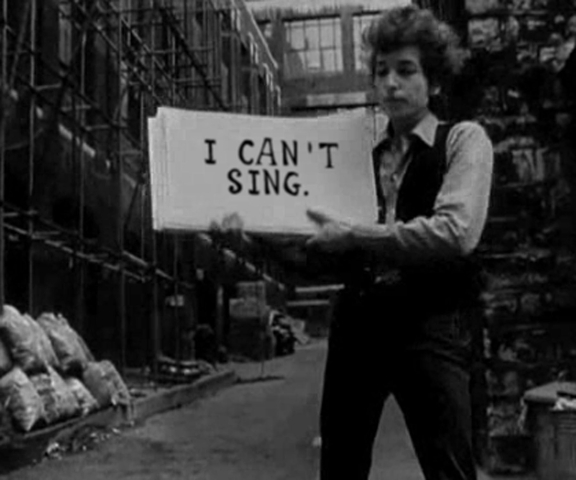
Posted: May 28, 2014 Filed under: Drag King Stories | Tags: androgyny, bob dylan, butch, drag, drag king, gender identity, genderqueer, lgbtq, lgbtqia, non-binary, performance, queer, trans, transgender 2 CommentsA few weeks ago, a friend asked me if I could portray Bob Dylan, as he were in Subterranean Homesick Blues. (My initial plan for “Drag King Stories” was to be chronological; obviously I’m not following that because I’m now jumping to the most recent story I have on the topic!) The friend had been invited by the local Improvement Society to give a power-point presentation at a literary/cultural hub, just up the street from me. He was going to be one of 11 people, doing flash-presentations to highlight what’s new!


His project: He is the mastermind behind a new radio station that will be hitting the airwaves by October. It’ll be run by and for the community; all funds will be raised by community efforts (as opposed to commercial, although there might be underwriters and/or sponsorship members).
So when he approached me, he said that each group presents 20 slides and a representative talks along with the images, which are on an auto-timer of 20 seconds each, for a total 6minute, 40 second presentation (per group). And the audience sits and watches each presentation, one after the other. He told me he’d already gotten permission to stray from the rules and just not use power-point or slides at all. To instead go totally lo-fi, using poster-board with words sharpied in black. Just my style!

In the past, any opportunity to be in drag and perform outside of a typical drag show format has been a total blast, and so I jumped on the chance. My friend and I hung out in his attic the Sunday before the event, listening to music, practicing, and drawing out the words with sharpie markers. He had written out a script, telling the story of the radio station thus far. I assumed a wide stance and stony expression, just like Mr. Bob Dylan. We decided in advance that I was going to have an attitude. I was just going to drop each poster onto the floor and then at the end of our 6:40, I would throw the last poster up into the air and walk off, leaving others to pick them all up.
We arrived early, and I was excited to find out we were on first. Love getting a performance out of the way and then kicking back! The audience was a bunch of young entrepreneurs / hipsters / yuppies / intellectuals. Haha. We got up there, did our thing, I walked off, and then we watched everyone else. There was an intermission with cucumber sandwiches, meats and cheeses, and tiny fingerling potatoes(?), and beer. This was, ultimately, a networking event, but I dislike that stuff, so I let my friend do the talking, and my partner and I grabbed food and beer and went to explore the building a little bit.

After the event, my partner and I went out to a bar to see a different friend’s new band. I felt really solid in my button-up shirt, vest, and sideburns. I should remember to go out “in drag,” just for fun, more often!
Also, if you wanna check out what I wrote in Part 1, it is here!

 janitorqueer