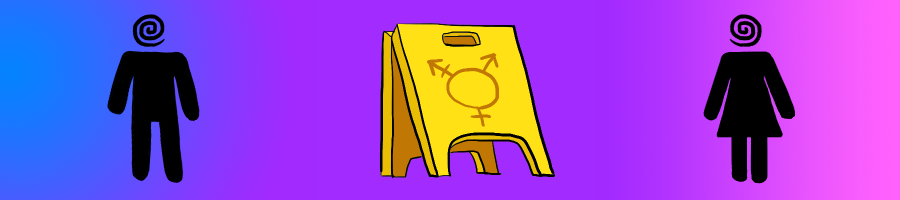
I keep thinking I’m bigger and more masculine than I actually am
Posted: October 21, 2014 Filed under: Janitorial work | Tags: androgyny, gender, gender identity, genderqueer, janitors, lgbtq, non-binary, queer, school, testosterone, trans, transgender, work 10 CommentsI’m not complaining; it’s not a bad thing! My surroundings sort of facilitate this, which is fine by me. As a janitor at an elementary school, I spend most of my time, during the work-week, with women and children (if I’m with anyone at all). Every teacher I interact with regularly is relatively feminine in her attire, mannerisms, and speech. (There are a handful of men who teach / work at this school; I just don’t happen to see them on a regular basis.) Every child running around me getting ready to head home for the day, is tiny. I wear a work uniform which is super masculine by default. (Like, we don’t have “women’s uniforms” and “men’s uniforms.” We just have uniforms.) In addition to the uniform, I wear men’s pants and men’s hiking boots. I imagine my movements are relatively masculine. I’m working, I’m using big, sweeping motions. I saunter around slowly, sometimes with my hiking boots untied.
I am surrounded all day long by tiny furniture. The classrooms I clean are for kindergarteners through 2nd graders. (My co-worker cleans the bigger kids’ rooms.) Some of these table tops are seriously 2 feet off the ground. I have to essentially bend in half in order to spray and wipe them all down, daily. (My poor back!)

Not an actual room I clean, but a good representation.
I’m only 5’4″ (or maybe a little shorter than that. I like to think I’m 5’4″ – I’m at least that with my hiking boots on!) but I feel like a giant! Sometimes I sit down in the teeny tiny chair at the teeny tiny table and just catch my breath / think / relax. It’s sorta like I’m in a fun house, where my self-perception is distorted because of my surroundings.

It’s tough to get your knees to fit under the table. Again, not actual school/teacher/kids, but a good representation.
I like this feeling a lot. It helps me feel more like the way I see myself. The only tough thing about it is when I get a glimpse of myself in the mirror (this happens at home too, it’s not just a work thing) and I realize how tiny and feminine I actually am! I seem to especially hone in on my neck, for whatever reason – it’s so dainty and slender and like it could snap right in half so easily. My wrists too; it feels like my hands could snap off at any time. These feelings don’t really translate into me feeling like I should be taking more testosterone and becoming more masculine. They’re just sorta… fleeting, at least for the time being.
Another thing that’s going on at work that’s somewhat related is: age. The kids stay the same; the parents stay the same. (Not really of course. Kids grow up. I just mean I’m perpetually surrounded by kids and parents around the same ages, they cycle through, while I get older and older.) I used to be the youngest person who worked at the school, for years. Now, there’s a teacher who is younger than me. When did that happen?! (It happened last year.) Also, parents keep looking younger and younger. Many of them are, in fact, younger than me now, which is a shift. In fact, just yesterday, a parent recognized me from high school. She was in a grade below me. It was super weird!
It’s just not the same as it used to be: kids and parents these days!
When No Gender Fits: Washington Post Article
Posted: September 24, 2014 Filed under: coming out | Tags: androgyny, article, coming out, gender, gender identity, genderqueer, lgbt, lgbtqia, media, non-binary, queer, trans, transgender 17 CommentsAbout five months ago, I did a phone interview with Monica Hesse of the Washington Post, as a potential candidate for an upcoming article about non-binary genders. She was planning on spending a few days with the person / people she selected; it wasn’t just a matter of chatting with her over coffee. It sounded really intensive and potentially uncomfortable at times. I thought the interview went well, and I talked to my partner about the possibility of her hanging around with us for a while. My partner was game. I was game.
I got back to her with a few reservations: When might this be, exactly? (I really love being able to plan ahead.) And, would you be coming to my work?!! (I am not out at work as non-binary, and I could not fathom her being there with me, at all.) She assured me that it was not a necessary part of her article, and it’d totally depend on who she ended up going with and what everyone was comfortable with. She seemed well versed in trans issues and understood the need for partial anonymity or a potentially incomplete story.
She had a lot more phone interviews to get through, and as we messaged back and forth, it became clear her interest in me was waning. I was pretty bummed. It sounded like something I was ready to challenge myself with! Of course, the disappointment faded with time. I’ve been looking forward to catching the finished article. Here it is!!!
When No Gender Fits: A Quest to Be Seen as Just a Person
I think this article is really well done. It covers important ground: pronouns, the internal isolation such an identity can bring (when society has no starting point for understanding), family and friend relationships, coming out issues. There is nothing sensational or hyped up about it – the reporter seems well informed and sensitive.
A major thing struck me. This article is about a very young person. Kelsey is 18 years old. They are at a completely different life stage than I am at. The article follows them over the entire summer. It appears that the reporter spent many many days with Kelsey, over a matter of 4 months or so. We get a glimpse into what’s going on, as they have concerns about clothing. As they have difficult conversations with their mom. As they go to a therapy appointment to discuss the possibilities of going on a low dose of testosterone. As they talk about teenaged things with their teenaged friends. As they meet someone they found through OKCupid, for the first time in person. As they pack up and plan for life at college.
“They will go to college. They will study engineering. They will get a job. They will find a partner and make a home. They will begin with finding a T-shirt.” This quote sums up the tone of the article.
Had I been the subject, it would have been nothing like this at all. I’ve been to college (glad that’s over with!!!). I have a job. I have a partner. We have made a home. I have a T-shirt. In fact, I have many T-shirts. Haha.
This story is no doubt important. However (and I’m definitely biased here, bordering on ageist maybe) I think it’s really really necessary that there are representations of older, established non-binary people. It’s not just a young people’s thing. (Not to imply that young people will be growing out if it – they won’t be!) I just mean that it’s not just something someone is focusing on at the time when they are naturally growing into their identities, just at the beginning of starting new chapters of their lives. There is, relatively speaking, a lot of representations (if even just online only) of young people, starting to question and figure these things out.
Gender identity issues are multi-generational. They are lifelong, and they come with different sets of challenges at different stages in life. I hope more media outlets will start jumping on the bandwagon (in respectful ways!) and more articles will pop up, with more frequency, soon. And that those articles will focus on other identities within non-binary genders, and different age brackets, different ethnic backgrounds, different socioeconomic backgrounds, etc.
And if I’m not seeing it, I’ve toyed with the idea of writing my own article, here. Like, pretending I am a reporter, looking in. Look for that in the near future, maybe!
1.5 years on T without noticeable masculinizing changes
Posted: September 18, 2014 Filed under: Testosterone | Tags: androgyny, gender, gender identity, genderqueer, hormone replacement therapy, hormones, lgbt, lgbtqia, non-binary, queer, testosterone, trans, transgender 4 CommentsIt’s been a year and a half! I increased my dosage of Androgel, slightly, about 3 months ago (from 1 pump of 1% daily to 1 pump of 1.62% daily), and still, I’m not seeing physical changes (which is still a big part of my goals). I have still not yet missed a day – applying the gel feels of utmost importance to me, as a part of my daily routine.
Nothing can be new forever, unfortunately. Naturally, I no longer have that same emotional reaction to applying the gel (anticipation, excitement). And I haven’t been thinking about it in the same ways as I did every single day for that first year (how totally fucking awesome it is). Still it feels very much essential. It’s not nearly as constant, but I do still reflect on how different things are for me now.
– I am grateful that I consistently feel like eating at regular intervals now.
– I’m grateful that I no longer feel quite as debilitated by anxiety-induced adrenaline surges
– I’m grateful that physical sensations make more sense. Pain actually feels painful. I don’t recoil from affectionate touches. When I take a deep breath, I feel a sense of calm and a connection to my body. Etc. forever.
– I’m grateful that sex finally makes sense, and that I get to be a part of it (usually. At least it’s much improved.)
– I’m grateful that although I’m still moody and seem to feel emotions relatively strongly, it’s become more manageable, and rarely manifests in self-destructive ways anymore.
– I’m grateful that I don’t feel so cold all the time!
– I’m grateful that things just feel easier, across the board.
I am genderqueer (in case you didn’t already know!) and am continuing to carve out a space in between genders. Or, to mix and match genders as I see fit. I feel like I’ve made a ton of progress in terms of finding that place where I feel like myself, in my own skin. Yet, not nearly enough progress in terms of seeing that identity reflected back to me from the world around me. This just means I have a long ways to go (And society has a much longer way to go. C’mon society, get with it!) until I really feel comfortable with the ways I’m seen by others. Luckily, that part is not nearly as important as the part about how I see myself. 🙂
Initially, I feel like I was being hyper vigilant about not crossing over into any masculinizing territory, especially with my voice dropping. As time has gone on, I’m not quite so concerned with this (although I’m not actually trying for it either.) I do wonder if my attitudes will change more, in this vein, and I’ll start to want to increase my dose even more and cross into that territory. Only time will tell. As of now, I’m feeling comfortable with where I am.
Here’s where I’ve been (there are lots of details about the subtle physical changes in these past posts):
Five months
Eight months
Eleven months
One year
A video at the one year mark
One point two-five years
And finally, a couple of pictures of my face:
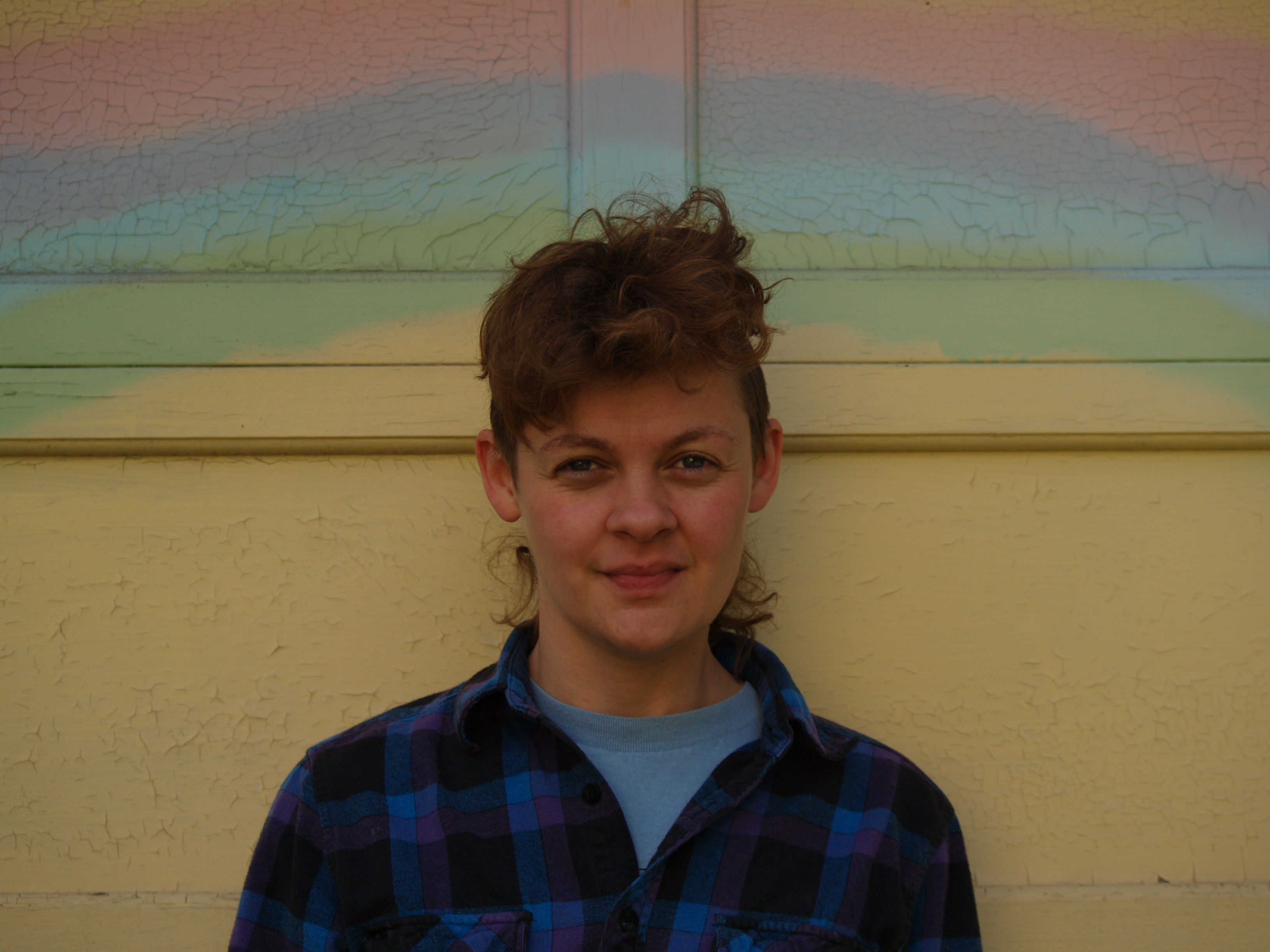
1.5 years on testosterone

1.25 years on testosterone

one year on testosterone
Good doctor news
Posted: August 21, 2014 Filed under: Testosterone, Uncategorized | Tags: androgyny, doctors, gender identity, genderqueer, hormone replacement therapy, lgbtq, lgbtqia, medical treatment, non-binary, queer, testosterone, trans, transgender 8 CommentsThree months ago, I finally found a good doctor, but I was unsure if I’d be able to keep her. I liked her style immediately – ability to communicate, upbeat and straightforward manner, etc. And I liked her entire office’s professionalism. However, she had no trans-related experience, and after I told her my reasons for being there, she seemed hesitant to keep me on as a patient. She said she would look into finding a specialist I could go to, or at the very least, that she could consult with before proceeding. In my head, I was thinking, “Good luck with finding people locally! How do you think I ended up here, with you?!!” Haha.
We had a follow-up appointment yesterday. Going into it, I wasn’t sure if she was just going to say, “So I’m going to refer you to so-and-so,” and I’d have to start all over again with someone new. I was nervous; I didn’t want that. I had convinced myself, to an extent, that that was what was going to happen.
If you’re interested in reading through this epic journey to find a new doctor, here’s where I’ve been, in backwards order:
From 3 months ago, Convincing doctors that hormones are not that complicated
From 5 months ago, The last time I saw my doctor / I like your product
From 6 months ago, Continued quest to find a new doctor (a good fit?)
And from 7 months ago, just simply, I need to get a new doctor
At the appointment, we first discussed the fact that I went to the eye doctor, and that my vitamin D is low and I need to get supplements, and then finally discussed the reasons I’m there. She said she did find two area specialists (one is an LGBTQ health center I’d rather not go through, and the other is an endocrinologist who focuses on adult health – good to know there is someone local, and that she uncovered him!) She continued to tell me she does not think it’s necessary for me to go through either of these channels unless I want to, and that she will continue seeing me for low-dose testosterone therapy. I was super happy but didn’t really let on. I did tell her I am glad I can keep coming to see her though. And that I don’t feel like I need to go to these other people unless something comes up.
I wonder what happened within that 3 month time span! I think she did some research. Or, in the process of reaching out to specialists, they conveyed to her that it was within her realm and abilities. And then she did some research. Something!
We discussed the labs I got done in May. My T levels were at 68 ng/dl. This surprised me quite a bit – previously, I was at 102 ng/dl. I had somehow, without changing a thing, dipped back into a normal female range. How does that work?
I know I should go by how I’m feeling, and not by numbers. BUT – is it just a coincidence that I increased my testosterone dosage 2 months ago, just kinda because? Because I felt like it? Hmmm. I’m super curious to know what my levels are now, accounting for the slight increase… I’ll find out in 3 more months… (More labs.)
Until then, I just wanna revel in the fact that I finally have a primary care physician I would feel comfortable going to for any issue that comes up with my body, trans-related or not. This is a first!
Words we use to describe ourselves
Posted: August 12, 2014 Filed under: coming out | Tags: androgyny, coming out, creativity, gender identity, genderqueer, identity, language, lgbtq, lgbtqia, non-binary, queer, trans, transgender 3 CommentsI recently mentioned an article called “A Gender Not Listed Here: Genderqueers, Gender Rebels, and OtherWise,” which is based on findings from a survey conducted in 2008. One of the most intriguing points to come from that (in my opinion) was all of the unique words and phrases respondents came up with to describe their gender. Some of those were: “jest-me,” “twidget,” “best of both,” “gender blur,” “cyborg,” and “genderqueer wombat fantastica.”
I also mentioned I had a list somewhere, where I had jotted down other terms. I found that list! So, to expand upon what respondents said:
- a variation of nature
- hybrid
- pangender
- ftx
- tranarchist
- and my favorite so far, “freemale.”
Also recently, Micah posted an ongoing poll which is generating a lot of great responses, as well. A few faves from that, so far:
- maverique
- limp-wristed butch
- boything
- gender-meh
- Alien Space Prince
- fae
- Royalty
- kinda like an old, beaten-in sneaker
- boydyke
- feyboi
- plastic
- epicene
This language is so important. Even if this is only how you see yourself internally, and you’d never actually use these words when you talk about yourself to others, the personal meaning behind it is rich with feelings of who we are, at our core.
As we try to sort out our identities, it is an amazing gift to have these options, all these creative bursts of self-expression, on hand for inspiration. Looking back roughly 12 years ago, when I was first considering the nuances of gender identitiy, I started to learn of the terms “butch,” “transgender,” “genderqueer,” and not a whole lot more. I remember someone referring to me as a “baby dyke” (because I’m so not butch), and that seemed maybe about right, but actually, no not really at all. At the time, I thought I felt like neither gender, like there was a void where there should be gender. I’ve come across dozens of ways to describe this experience lately, but at the time, I struggled with describing what that was, even if just to myself.
These days, I do not feel devoid of gender. The way I replied to Micah’s survey was, “A kaleidoscope of all genders.” That feels exactly right. It feels like a rich mixture, flowing through my being, and constantly shifting internally, but held together by a relatively stagnant vessel (my body). I mean, my body is in motion, but it’s not changing as much as many people who are trans. Nor does my gender expression shift much. It’s an internal feeling.
I wanna recommend this blog post, from a mother’s perspective. She showed her son Micah’s question about how you describe your gender and they talked about some of people’s responses. And it really seemed to open something up for him. This is the kind of stuff we need!
Got descriptive words to add? Join the conversation!
“A Gender Not Listed Here”
Posted: July 30, 2014 Filed under: Uncategorized | Tags: androgyny, coming out, gender identity, genderqueer, lgbtq, lgbtqia, non-binary, Philadelphia Trans-Health Conference, queer, statistics, survey, trans, transgender 7 CommentsI attended the Philadelphia Trans-Health Conference back in mid-June and wrote a summary of the workshops I made it to, but I left out the details of one workshop because I felt it warranted a post all to itself. I stumbled into “A Gender Not Listed here” late Saturday afternoon, feeling a little bit drained, but excited about the topic, which was going to be a summary and discussion of an article that was published in April, 2012. The information was based on findings of a study completed by the National Gay and Lesbian Task Force and the National Center for Transgender Equality in 2008. It surveyed 6,450 T-GNC-GQ (transgender, gender non-conforming, genderqueer) individuals from all 50 states, the District of Columbia, Puerto Rico, Guam, and the U.S. Virgin Islands. It is by far the largest sample size of this population to date.
(The presenters commented that they got a lot of flak from peers ahead of time – their colleagues thought it was foolish to put forth a 70 question survey, claiming people would not fill it out in its entirety. To then see the number of completed surveys that came back is really a testament to how much this community craves to be heard, to share their thoughts, opinions, and identities.)
So, to reiterate, the survey was for anyone who identifies as transgender / gender non-conforming. Question #3 of the survey asked, “What is your primary gender identity today? 1.Male/man, 2.Female/woman, 3.Part time as one gender, part time as another, 4.A gender not listed here, please specify _________” This workshop honed in on the 13.3% of people who answered question #3 of the survey with option #4. Most of the data was about how this statistically relates to other factors such as age, ethnicity, education, region, household income, and discriminatory factors (employment, health and health care, violence, etc.)
It was totally eye opening! I had no idea this data has been out there, for a couple of years now. Even just the knowledge that about 13% of people who identify as transgender also identify as neither male nor female (or living part time as such) is mind-blowing. Not mind-blowing as in it’s surprisingly lower or surprisingly higher than I might have imagined (it’s not). But mind-blowing as in there actually is a statistical estimate out there, at least for the US. And why is this study not more widely known?!!
I’m not going to pick apart all the details of the statistical analyses, but I hope you might want to take a glance. Here is a summary of the report, broken down really nicely: Check out this modified version!
If you’re feeling ambitious and want to read the full 12 page report, it is here: Genderqueers, Gender Rebels, and OtherWise!
A general overview might go something like this: Those people who wrote in their own gender tend to be younger, more educated, less financially stable, and less likely to live in the midwest or south, and less likely to be white than their transgender counterparts. Also, it has been determined that:
“Despite their resilience and ability to define themselves in broader terms and to hold [different] ideas of identity in mind than conventional notions, overall Q3GNL participants face greater discrimination, risk, and violence than their transgender counterparts in most of the survey categories.”
Of course factors of privilege come into play, and it’s so convoluted to suss out what factors may lead to or predict other factors. It’s simply a large data set from which future research can build from. That’s part of the beauty of it – this information is public. So, for example, if you’re a grad student who needs a thesis topic, or you’re just really good at stats and have lots of free time on your hands, there is plenty of work still to be done and conclusions to draw from the raw data. Hopefully many will work with it in the future.
One other interesting point to highlight is word choice: Since the question made room to fill in the blank, the range of terms for self-expression ended up being huge. 39% of Q3GNL participants wrote in “genderqueer,” 9.5% wrote in “both/neither, in-between, or non-binary,” 2.2% wrote “fluid.” …
16.8% chose another term all together, and that generated a list of over 100 unique words / phrases, including “jest-me,”twidget,” “best of both,” “gender blur,” “cyborg,” and “genderqueer wombat fantastica” hahaha. I know I wrote down a list of a lot more, at the conference. The presenters did a powerpoint presentation and the slide with all these identity ideas generated a lot of discussion. As soon as I find that list, I will post whatever else it was that I wrote down.
Feels like I wanna get more creative with how I might describe myself!
Happy pride weekend
Posted: July 19, 2014 Filed under: coming out | Tags: androgyny, balloons, celebration, gender identity, genderqueer, lgbt, lgbtq, non-binary, parade, pride, pride parade, queer 4 CommentsI know that pride month is long over, and it would appear I’m quite a bit behind, but this actually is when Pride happens in our city. I’d been having a glum summer so far, and this day really helped lift my spirits. My partner and I marched in the parade with the local gay alliance (the one I’ve been doing office volunteer work with, since January).

I woke up early to help create 8 balloon “backpacks” to be worn at the parade. I didn’t end up claiming one to wear, so my partner and I decided to create our own balloon backpacks, you know, so we would fit in better.
As we marched, I seriously could feet the pride sinking in, for real. The parade followed a new route this year, and it was a definite improvement. Lots of people cheering, protesters much less prominent (for whatever reason.) My partner and I held hands for a while! I said hi to and hugged other people I knew from the alliance. It feels super great to know I’m starting to become more connected to this community, a little bit.

helping someone put on their balloon “backpack” while wearing my own!
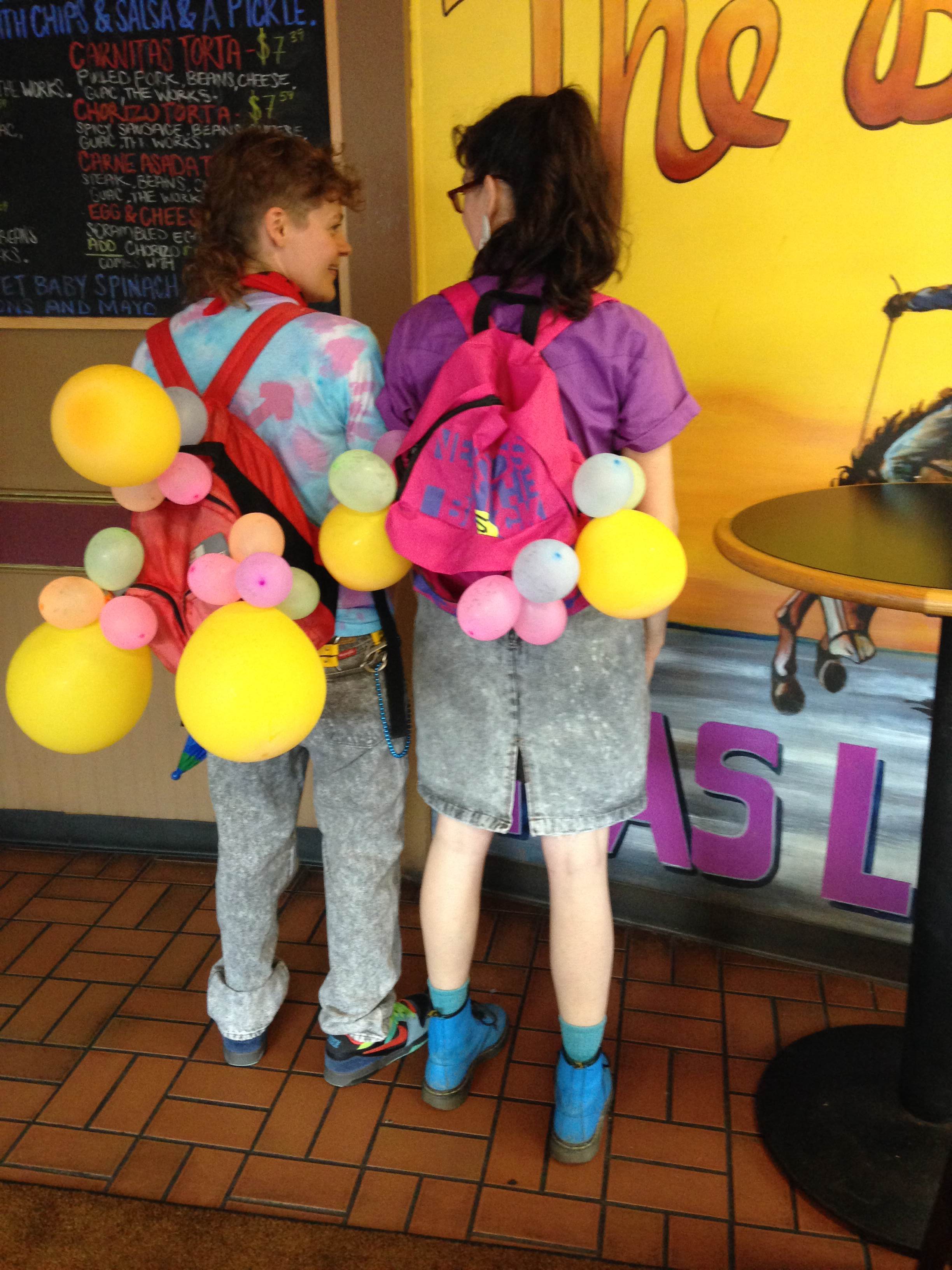
We went to a burrito place after the parade.
This was not my first time marching in the parade, not by a long shot. But it was my first time marching with a group, legit. For about 7 years straight, I would merge in with the parade to do my own thing, sometimes with my partner and friends, sometimes just with my drag buddy. In my own way, I was protesting the fact that groups have to pay for a spot. I strongly felt that, even though I didn’t belong to a group, I belonged in the parade. It was always kinda chaotic. Frenzied, manic energy (sort of forced, sometimes).
We walked with boomboxes playing our fave song (not the club hits.) We rode our bikes. We handed out flyers for radical queer reading groups, for performance nights, for the anarchist community space. We gave away candy and hugs. We hoola-hooped, danced, ALWAYS created huge gaps between ourselves and those in front of us (accidentally) because we were interacting with the crowds so much which caused us to delay walking forward, haha. At some point, it started to feel exhausting, but I kept thinking I had to keep doing it – it was a tradition. Last year, I let myself off the hook, didn’t even attend. This year, we’re figuring out different ways to do it. It felt pretty great.
I read some reflections on Pride this past month – that it’s corporate, that it’s not inclusive, that it’s not worthwhile or necessary any longer. If, by chance you do feel this way, next year, consider making Pride your own by merging into the thick of it, or streaking through the middle of it, and giving voice to whatever it is you feel you want to say. Be the people you feel you’re not seeing!

2007

2008

2010

2009
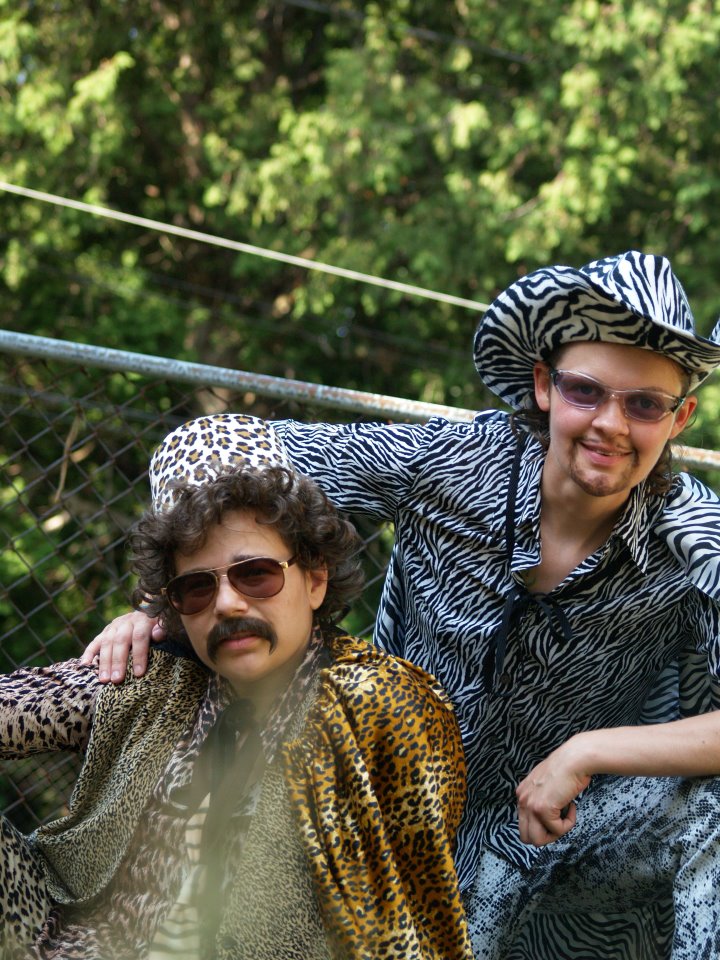
2012

2011
Why I avoid checking the box
Posted: July 12, 2014 Filed under: Uncategorized | Tags: androgyny, bureaucracy, gender identity, gender neutral, genderqueer, legal forms, lgbtq, non-binary, queer, third gender, trans, transgender 13 CommentsThis is the last part of a 3-part series exploring some issues that are on the minds of a lot of non-binary people, including myself. Part one was about pronouns. Part two was about bathrooms. This post is about legal designations / filling out forms.
Great timing on this one! A few months ago, I signed an online petition requesting that the executive branch legally recognize genders outside of the male-female binary and provide an option for these genders on all legal documents and records. Just yesterday, I got a response from The White House, in my inbox! Er, I mean, you know, it’s a mass email, a form reply for all petition signers, but really, how cool is that when I was preparing to write about this topic anyway?!!
Here is an excerpt:
We know how important this issue is, and we understand the profound impact, both symbolic and otherwise, of having official documents that accurately reflect an individual’s identity. These documents play an essential, functional role, but also demonstrate the measure of dignity and respect afforded to our nation’s citizens. We cannot overstate the care and seriousness that should be brought to bear on the issue.
We recognize the importance of gender identification in particular and the Obama Administration is working to modernize federal policies in this area. For example, in 2010, the U.S. Department of State made it easier for individuals to update the gender marker in their passports. And last year, the Social Security Administration followed suit by simplifying the process for individuals to change the gender marker on their social security cards to reflect their identity accurately.
As you can imagine, there is considerable variance across agencies and levels of government. And so while the Obama Administration wants to make sure that official documents reflect the identities of the Americans who hold them, we believe proposals to change when and how gender is listed on official documents should be considered on a case-by-case basis by the affected federal and state agencies. However, that consideration must be informed by best practices and a commitment to honoring individuality and ensuring fairness.
So, it sounds like a polite, “No.” If you want to read the entirety, it is here: We the People Petition on Non-Binary Genders. In this world of constant feedback loops, you can also let the government know what you think of their response, share on Facebook and Twitter, etc.
Personally, this is the thing I want the most. In my two previous posts, I explained that although I identify strongly with being non-binary, I actually am not strongly bothered by gendered pronouns (I prefer male pronouns) or gendered bathrooms (I use the women’s bathroom). In general, I attempt to mix and match gendered options to optimize my comfort level, and that has usually worked for me. But when it comes to declaring, “I am male” or “I am female,” I simply cannot do it. Legally, I am female, simply because it is the default in this case. I would not seriously consider legally changing my gender unless I can change it to a gender-neutral option (and if I could, I would do it ASAP). Legal stuff feels like a more black and white, either/or arena than bathrooms, pronouns, and anything else in the real world which is comparatively flexible and fluid. What I mean by this is, for example, I like when people say,”sir,” “man,” and use male pronouns because they’re seeing me, we’re interacting, and that interaction has the potential of being nuanced, fluid, changing. I could walk in the women’s bathroom today, and tomorrow decide to go in the men’s, without too much consequence (hopefully) if I wanted or needed to.
The legality of being one gender or another seems so much more finite, set-in-stone, weighty. And I want another option!!!!! People in Australia, as of a few months ago, are able to pursue a “non-specific” designation. I want to be able to as well! (Although, I didn’t realize this until looking into it just now, but Australian citizens pursuing this must present medical proof of gender confirmation surgery. It would be important, ultimately, for medical transition status to not play any part in this designation – just my very very strong opinion.)
Until I have this option, I will continue to evade declaring my gender as often as I can. I will continue to leave it blank on forms whenever possible, and to explain the nuance if the opportunity arises. As of now, if my gender is not listed on a form, my (very feminine) legal name will immediately give me away anyway. So although I have no plans to legally become male, I do plan to legally change my name to something ambiguous. And as soon as I start hearing about smaller instances where a “non-specific,” “non-binary,” “X,” or whatever the term may be, is a possible option, I will start pursuing it. Even if that means I’m listed as “F,” on some things and “X” or whatever on others. It’s going to start on a small scale (like doctor office forms, maybe things like library card applications, etc.) It’s already started! And just build and build from there. All the way up to driver’s license, passport, and birth certificate. One day, I hope…
Why I use the women’s bathroom
Posted: July 6, 2014 Filed under: Uncategorized | Tags: androgyny, bathrooms, gender identity, gender neutral bathrooms, genderqueer, lgbt, lgbtq, non-binary, queer, restrooms, safety, trans, transgender 5 CommentsThis post is part 2 in a series about some issues that are on the minds of a lot of non-binary people. Part 1 was about why I prefer male pronouns. Today I’m talking about bathrooms. Part 3 will be about legal designations / filling out forms.
I am someone who is inhabiting a space in this world, in between genders. There is a growing language, subculture of sorts, and political agendas surrounding this experience. In theory, I am on board with all I’ve seen (and let me clarify that what I’ve seen is almost entirely online at this time, and not reflected in the world I actually live in). But in actuality, not every part of it appeals to me personally. Which is OK – I can still support it while simultaneously getting the word out that not all non-binary people have the same needs, preferences, and agendas.
In general, I use the women’s restroom. The reason for this is: because it is where I would rather go, despite the fact that I see myself in more masculine terms, overall. No need for a further explanation – no need to try to align different areas of my life into one gendered idea of myself (even if that one gendered idea is “gender neutral,”) if I don’t feel like it.
If there is a single stall / gender neutral one available, I would prefer to use that bathroom. But usually there is not, and it is not something that I am personally concerned about. I feel comfortable enough in the women’s restroom. I don’t have any anxiety about it. I don’t second guess it. I’ve rarely been confronted (I keep my head down, avert my eyes, I don’t linger, etc. I am aware I don’t completely belong, so I wanna be as inconspicuous as possible, and so far so good.)
(I wrote an earlier post about my experience with bathrooms, here, at Bathroom anxieties: a genderqueer janitor’s perspective.)
However, many non-binary and transitioning people do not feel safe and/or comfortable in either the women’s or the men’s restroom. Indeed, they are often made to feel unsafe and uncomfortable. There has been a push for more gender neutral bathrooms in public places, over the past few years, particularly at schools and on campuses. Why schools and campuses? I’m not sure exactly, but I can make an educated guess. People in their teens and early twenties are at these places en masse. People in their teens and early twenties tend to be going through changes – they may be focusing on their identities (including gender identities) more so than the general population, so it makes sense they would want to change the spaces where they spend the most time, in order to feel more safe and comfortable.
I hope this movement spreads beyond schools, to include government buildings, corporate chains, every place, really. I think that it will, or, at least, I think this agenda will gain more traction than the push for gender neutral pronouns, which is, comparatively speaking, somewhat nebulous. changes in language are more about changing people’s perceptions and notions on a large scale (potentially very difficult). Bathrooms are about physical spaces, with a direct request that involves a straightforward solution.
New buildings can go up with this floor plan in mind, without much more money or labor. Existing buildings can be remodeled and reorganized. (Something that happens frequently anyway.) Often it’s just a matter of relabeling existing layouts (at no additional cost). For example, if a restaurant has a single stall restroom for men, and a single stall restroom for women, how much work would it take to get that restaurant to just change them both to gender neutral bathrooms? Hopefully within the near future, not much convincing work at all!
Until this is happening anywhere and everywhere (I hope I see the day!!!!), here is an amazing website resource: Refugee Restrooms.
All you have to do is type in your city or location, and it is a database that lists where there are single stall handicap accessible and/or gender neutral restrooms in that area. The database is only as big as everyone makes it, so if you know of bathrooms in your area, go ahead and type in the locations now! I started adding some for my city; let’s spread the word!
Why I prefer male pronouns
Posted: June 30, 2014 Filed under: Uncategorized | Tags: androgyny, coming out, gender identity, gender neutral, genderqueer, language, lgbtq, non-binary, preferences, pronouns, queer, trans, transgender 22 CommentsI am someone who is inhabiting a world in between genders. There is a growing set of words, a subculture of sorts, and there are political agendas surrounding this experience. And in theory, I am on board with all I’ve seen (and let me clarify that what I’ve seen is almost entirely online at this time, and not reflected in the world I actually live in). But in actuality, not every part of it appeals to me personally. Which is OK – I can still support it while simultaneously getting the word out that not all non-binary people have the same needs, preferences, and agendas.
I’m going to go with a break-down of three categories: Pronouns, Bathrooms, and Legal Designations / Forms. And talk a little about the discussions I’ve seen, but also how I personally feel.
Pronouns: I prefer to be referred to with male pronouns: He/Him/His. The reason for this is: because it is my preference. It really is as simple as that – no explanation needed. It feels the most right (although no pronouns actually feel “right” for me). That’s all it comes down to – a feeling.
Many non-binary people go by They/Them/Their, along with a myriad of more obscure pronouns. Some people have assumed that I go by They/Them/Their, because I identify as non-binary. That is fine. It’s not my preference, but I’m not offended by this assumption, nor do I mind being referred to in this way. I have felt some pressure (from within myself only) to adopt the They/Them/Their/ set in order to align myself more with an idea of a non-binary identity, and to take a stand / stand-out more for what some people truly feel they need (which is to be referred to with gender neutral pronouns – it is definitely a need for some people). But, bottom line, it does not feel right for me. Male pronouns feel (more) right.
(And I imagine if I really break it down, this correlates to how I see my gender: I do not feel as if I am without gender, genderless, agender, or gender neutral. Instead, I feel as if I am an amalgam of genders, a kaleidoscope. And so it feels right that I view my identity’s make-up as pieces from all genders, rather than a rejection of anything that is gendered.)
I have seen many preferred sets of pronouns online (such as Ze/Hir/Hirs, Ey/Em/Eir/Eirs, Xe/Xem/Xyr/Xyrs and also ones based off of nouns). But in actual real life, I have come into contact with only one person, so far, with a preference for a set like this – and I immediately proceeded to mess it up when talking out loud. I have met a couple of people who prefer They/Them/Their, and that feels immediately do-able in real life, because these are words we’re all familiar with pronouncing. And… that’s kinda the difference – much of the online world is written, it’s visual. And it’s easy to backspace and try again. The real world involves much more talking out loud, at a conversational pace, and I personally am a long way from incorporating these newish words naturally into a conversation. That doesn’t mean I’m not willing to. It doesn’t mean I don’t support it. It means, in practice, I have a lot of work to do. And that work is difficult to do if I do not have people in my life who want to be referred to in this way – it’s hard to practice if I’m not actively practicing, essentially. And, since I am someone who identifies as non-binary, I might be, in theory, someone on the most sensitive, most open, end of the spectrum, in terms of the general populous. I have a lot of trouble with it, from a practical perspective, at this time.
To summarize: Incorporating these newer pronouns is do-able. I support it. For some people, it is not a preference, but a need, in order to feel comfortable. I personally do not need or prefer to be referred to by gender neutral pronouns. I have a long way to go in terms of enacting this language. Which, I believe, means the general population has a much longer way to go. It’s hard to make progress if I’m not actively using the words in regular conversation. At this time, I am not actively using the words in regular conversation. This is where I’m at with pronouns. It’s hard to gauge where the world at large is at, but I imagine progress will be very very slow. I’m just thinking pragmatically here. Ideally, I wish it were easy.
This got a lot longer than I thought it would. It’s complicated! So again I’m going to break the topics up; look forward to yet another series! Up next: part 2 – Bathrooms and part 3 – Legal Designations / Forms.

 janitorqueer